Glugea hertwigi
Weissenberg, 1911
Common Name:
A microsporidian parasite
Synonyms and Other Names:
disease known as microsporidiosis
Identification:
The parasitic spores of G. hertwigi have thick cell walls with rough, wrinkled and loosely folded surfaces. The sporoplasm contains a nucleus and free ribosomes and is surrounded by a plasma membrane. It can be injected into a host cell via a thin polar tube, which is held coiled inside the spore until it is discharged. This tube is surrounded at the base by a polaroplast, or arrangement of membranes or vesicles. In the digestive tracks of host Rainbow Smelt (Osmerus mordax), cysts with up to 200 spores can form (Nakajima and Egusa 1979; Weidner et al. 1984; Scarborough-Bull and Weidner 1985; Pekcan-Hekim et al. 2005).
Spores are 3.5–5.5 μm by 1.5–2.6 μm in size. There is great variation but most populations fall at the larger end of the range. Smaller spores may be a specific variety of this species, proposed to be canadensis (Delisle 1969; Delisle 1972; Scarborough-Bull and Weidner 1985). Cysts range in size from 0.2–5 mm in diameter (Nepszy and Dechtiar 1972; Pekcan-Hekim et al. 2005).
Size:
Spores are 3.5–5.5 μm by 1.5–2.6 μm in size. Cysts range in size from 0.2–5 mm in diameter.
Native Range:
G. hertwigi was first recorded from smelt in the Baltic Sea and is considered native to Europe (Mills et al. 1993; Pekcan-Hekim et al. 2005).
|
|
|
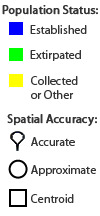
This map only depicts Great Lakes introductions.
|
|
Great Lakes Nonindigenous Occurrences:
The first Great Lakes occurrence of Glugea hertwigi was reported in 1960 from Rainbow Smelt (Osmerus mordax) from Lake Erie at Port Dover and Wheatley, Ontario (Dechtiar 1965b ; see also Chen and Power 1972, Dechtiar 1972a, Dechtiar and Nepszy 1988, Nepszy and Dechtiar 1972, Nepszy et al. 1978, Nsembukya-Katuramu et al. 1981).
Table 1. Great Lakes region nonindigenous occurrences, the earliest and latest observations in each state/province, and the tally and names of HUCs with observations†. Names and dates are hyperlinked to their relevant specimen records. The list of references for all nonindigenous occurrences of Glugea hertwigi are found here.
Table last updated 2/22/2026
† Populations may not be currently present.
Ecology:
HABITAT - Glugea hertwigi typically infects euryhaline smelt species in the genus Osmerus, but it has also been recorded from Pond Smelt (Hypomesus olidus) and some Coregonus spp. (Dykova 1995). In the Great Lakes, Glugea hertwigi has been found only in Rainbow Smelt (Osmerus mordax). G. hertwigi was originally known from marine environments but is now known to thrive in freshwater environments, as well. Infection occurs via spores that enter through water taken in by the fish. Glugea hertwigi infection first occurs in the anterior digestive tract, but cysts can also spread to the posterior digestive tract, liver, pyloric caeca, heart, gonads, fins, and skin (Dechtiar 1965b, Dechtiar 1972a, Nepszy et al. 1978, Putz et al. 1965). The number of parasitic cysts in smelt populations typically peak between August and September (Pekcan-Hekim et al. 2005), although die-offs occur in Quebec in both spring and fall (Delisle and Veilleux 1969). Cyst growth may increase with increasing water temperature (Delisle 1969). However, as spores frequently enter both juvenile and adult fish at maximum water temperatures, the largest cysts may not appear until after this time (Pekcan-Hekim et al. 2005). Younger smelt appear more vulnerable to infection, while older smelt may have increased immunity (Pekcan-Hekim et al. 2005). FOOD WEB - Glugea hertwigi is a parasite that feeds on its host.
LIFE HISTORY - Glugea hertwigi develops in the cytoplasm of host cells. It causes nuclear division without cytokinesis, resulting in one large cell up to 0.5–1 mm in diameter filled with many nuclei. Parasitic spores mature in a central vacuole in the enlarged host cell, undergoing schizogony, or asexual reproduction, many times. Once the spores have finished reproducing, the host cell ruptures and the parasites are eventually released into the water column to be ingested by new hosts. Environmental spores may be concentrated by plankton on which the host fish feeds (Scarborough 1979). In new hosts, they attach to the digestive tract or other organs. The sporoplasm is then discharged from the spore case at high pressure, entering the host cell. The sporoplasm reorganizes before, during, and after ejection, and the resulting mass is larger than it was inside the spore case. Spore discharge can be triggered by a large change in pH to highly alkaline conditions (Delisle 1972, Scarborough-Bull and Weidner 1985, Wellings et al. 1969).
Great Lakes Means of Introduction:
This parasite was introduced to the Great Lakes with its host, Osmerus mordax, which in turn was introduced via stocking and/or dispersal through canal systems (Mills et al. 1993).
Great Lakes Status:
Overwintering and reproducing in Lakes Erie and Ontario. Despite lack of recent verified identification, fish kills consistent with this species continue.
Great Lakes Impacts:
Summary of species impacts derived from literature review. Click on an icon to find out more...
| Environmental | Socioeconomic | Beneficial |
|
|
| | | |
There is little or no evidence to support that Glugea hertwigi has significant environmental impacts in the Great Lakes.
In the Great Lakes, G. hertwigi exhibits host specificity for non-native Rainbow Smelt (Osmerus mordax) (Muzzall and Whelan 2012), a species which competes with and feeds on several important native and non-native species in the Great Lakes food web. Glugea hertwigi is known to damage the mesentery, intestinal organs, and gonads in Rainbow Smelt. Such parasitism by G. hertwigi can be lethal or non-lethal (Pekcan-Hekim et al. 2005). Infections in the stomach and intestine can cause starvation and intestinal poisoning (Chen and Power 1972, Delisle 1972, Mills et al. 1993, Pekcan-Hekim et al. 2005, Scarborough and Weidner 1979). Die-offs of Rainbow Smelt as a result of G. hertwigi infection have the potential to indirectly cause cascading food web effects in the Great Lakes.While there is no evidence of native coregonid infection in the Great Lakes, G. hertwigi is known to parasitize Coregonus species in northern Russian lakes (Dykova 1995).
There is little or no evidence to support that Glugea hertwigi has significant socio-economic impacts in the Great Lakes.
Glugea hertwigi has been implicated in mass mortalities of the introduced Rainbow Smelt (O. mordax) in Lake Erie (Nepszy and Dechtiar 1972, Nepszy et al. 1978) and Lake Ontario (A. Dechtiar, unpublished data). Mortality events are believed to be seasonal and directly related to parasite prevalence (Dechtiar and Nepszy 1988).
There is little or no evidence to support that Glugea hertwigi has significant beneficial effects in the Great Lakes.
Declines in Rainbow Smelt as a result of G. hertwigi infection has the potential to improve resource availability for native Great Lakes species.
Management:
Regulations
| Jurisdiction | Regulation | Law | Description | Date Effective |
| Illinois | Other | 515 ILCS 5/20-90 | This species is not on the Illinois Aquatic Life Approved Species List and if it is not otherwise native to Illinois it is illegal to be imported or possessed alive without a permit. | 7/9/2015 |
Note: Check federal, state/provincial, and local regulations for the most up-to-date information.
Control
There are no approved control methods for this species. A prototype intraperitoneal vaccine specific for G. hertwigi was developed for use in aquaculture (Harkness et al. 2013).
Note: Check state/provincial and local regulations for the most up-to-date information regarding permits for control methods. Follow all label instructions.
References
(click for full reference list)
Author:
Kipp, R.M., A.K.Bogdanoff, A. Fusaro and R. Sturtevant
Contributing Agencies:


Revision Date:
9/2/2025
Citation for this information:
Kipp, R.M., A.K.Bogdanoff, A. Fusaro and R. Sturtevant, 2026, Glugea hertwigi Weissenberg, 1911: U.S. Geological Survey, Nonindigenous Aquatic Species Database, Gainesville, FL, and NOAA Great Lakes Aquatic Nonindigenous Species Information System, Ann Arbor, MI, https://nas.er.usgs.gov/queries/GreatLakes/FactSheet.aspx?NoCache=4%2F3%2F2010+9%3A53%3A34+PM&Species_ID=2368, Revision Date: 9/2/2025, Access Date: 2/22/2026
This information is preliminary or provisional and is subject to revision. It is being provided to meet the need for timely best science. The information has not received final approval by the U.S. Geological Survey (USGS) and is provided on the condition that neither the USGS nor the U.S. Government shall be held liable for any damages resulting from the authorized or unauthorized use of the information.