Conticribra (Thalassiosira) guillardii
(Hasle) K. Stachura-Suchoples & D.M. Williams
Common Name:
A centric diatom
Synonyms and Other Names:
Identification:
This cylindrical diatom species typically contains 2–6 disc-like chloroplasts. It usually occurs singly but may occasionally form colonies of a few cells connected via threads. There may be 0–12 central fultoportulae and 1 labiate process. The central area generally exhibits a siliceous irregularly shaped ring. Slightly raised costae branch out from the central area on the valve face and may be more or less granular and siliceous, depending on the silica content of the water. Pores on the valve face are somewhat haphazardly distributed in radial rows; areolae are located near the valve margins. Areolae or distinct costae are typically also apparent on the mantle (Hasle 1978, Kiss et al. 1984, Trigueros et al. 2000).
Size:
4–35 µm diameter
Native Range:
Exact native range is unclear. Contricribra guillardii is widespread, but not all the locations where it has been recorded may be part of its native range. It occurs in the Pacific and Atlantic Oceans in coastal waters, the Baltic Sea (type locality), some European river drainages such as the Weser, Danube, Thames, and Tisza, and even in Lake Balaton, Hungary (Hasle 1978, Kiss et al. 1984, Kiss and Padisak 1990, Mills et al. 1993, Shevchenko et al. 2003).
|
|
|
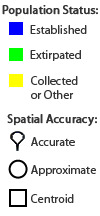
This map only depicts Great Lakes introductions.
|
|
Great Lakes Nonindigenous Occurrences:
Contricribra guillardii occurred in Sandusky Bay, Lake Erie for the first time in 1973 (Mills et al. 1993). Possibly present in Duluth-Superior Harbor, but taxonomy is not confirmed (Personal Communication, E. Reavie 2024).
Table 1. Great Lakes region nonindigenous occurrences, the earliest and latest observations in each state/province, and the tally and names of HUCs with observations†. Names and dates are hyperlinked to their relevant specimen records. The list of references for all nonindigenous occurrences of Conticribra (Thalassiosira) guillardii are found here.
Table last updated 6/5/2026
† Populations may not be currently present.
Ecology:
Conticribra (Thalassiosira) guillardii is a primarily marine diatom with a broad tolerance for brackish conditions and occasionally found at high concentrations in freshwater (Hasle 1978, Trigueros and Orive 2000, 2001,Trigueros et al. 2000). | Environmental Parameter | Value | Source |
| Salinity Range | 4-35ppt | Trigueros and Orive 2000 |
| Salinity Preference | 18-20ppt | Trigueros and Orive 2000 |
| Temperature Range | 7-24.5°C | Trigueros and Orive 2000, 2001; Trigueros et al. 2000 |
| Temperature (peak bloom) | 21°C | Trigueros and Orive 2000, 2001; Trigueros et al. 2000 |
C. guillardii is capable of sexual reproduction.
Great Lakes Means of Introduction:
Contricribra guillardii was very likely introduced to the Great Lakes basin via ballast water (Mills et al. 1993).
Great Lakes Status:
Uncertain. This species has been confirmed only once in the Great Lakes (Mills et al. 1993, Hasle 1978); however, this taxon is difficult to distinguish from other Thalassiosira species using light microscopy. Even potential sightings have been infrequent.
Great Lakes Impacts:
Summary of species impacts derived from literature review. Click on an icon to find out more...
There is little or no evidence to support that Contricribra guillardii has significant environmental impacts in the Great Lakes.
Contricribra guillardii has been recorded at abundances reaching 95% of the diatom community in locations outside of the Great Lakes, although it is more typically less abundant in freshwater (Hasle 1978). In the Great Lakes, C. guillardii has only been recorded once (Sandusky Bay, OH), and the abundance of this sample compared to the rest of the phytoplankton was not recorded (Hasle (1978).
There is little or no evidence to support that Contricribra guillardii has significant socio-economic impacts in the Great Lakes.
There is little or no evidence to support that Contricribra guillardii has significant beneficial effects in the Great Lakes.
Management:
Regulations | Jurisdiction | Regulation | Law | Description | Date Effective |
| Illinois | Other | 515-ILCS 5/20-90 | This species is not on the Illinois Aqautic Life Approved Species List and if it is not otherwise native to Illinois it is illegal to be imported or possessed alive without a permit. | 7/9/2015 |
Table last updated 7/5/2022.
Note: Check federal, state/provincial, and local regulations for the most up-to-date information.
Control
Chemical
Contricribra guillardii is a brackish water species. Therefore, the reduction of pollution and nutrient runoff could decrease the viable habitat for C. guillardii.
Note: Check state/provincial and local regulations for the most up-to-date information regarding permits for control methods. Follow all label instructions.
Remarks:
It should be noted that early slides from 19th century Lake Erie are not well preserved and cannot be used to conclude whether or not C. guillardii was present at that time (Hasle 1978). In 1958, Guillard isolated three diatom clones from an estuary (3-H), slope water (7-15), and open ocean region (13-1). They were all greatly studied and considered to be different forms of C. pseudonana. However, it turns out that clone 7-15 is identical to C. guillardii from brackish water. Clone 3-H is still considered to be C. pseudonana, and clone 13-1 is considered to be a third species (Hasle 1982).
References
(click for full reference list)
Author:
Kipp, R.M., M. McCarthy, and A. Fusaro
Contributing Agencies:


Revision Date:
10/11/2024
Citation for this information:
U.S. Geological Survey, 2026, Conticribra (Thalassiosira) guillardii (Hasle) K. Stachura-Suchoples & D.M. Williams: Nonindigenous Aquatic Species Database, Gainesville, FL, and NOAA Great Lakes Aquatic Nonindigenous Species Information System, Ann Arbor, MI, https://nas.er.usgs.gov/queries/GreatLakes/FactSheet.aspx?Species_ID=1690, Revision Date: 10/11/2024, Access Date: 6/5/2026
This information is preliminary or provisional and is subject to revision. It is being provided to meet the need for timely best science. The information has not received final approval by the U.S. Geological Survey (USGS) and is provided on the condition that neither the USGS nor the U.S. Government shall be held liable for any damages resulting from the authorized or unauthorized use of the information.