Stephanodiscus subtilis
(Van Goor) A. Cleve, 1951
Common Name:
A centric diatom
Synonyms and Other Names:
Melosira subtilis van Goor, 1924
Identification:
This small and delicate diatom species generally forms cylindrical chains that range from a couple to over 30 cells long. Valves may be convex in the center. Irregular, rectangular areolae are typically arranged radially in uneven rows. There may be weakly silicified radial striae. Variously shaped spines generally occur around the valve rims. Cells typically contain two disc-like chromatophores (Kuzmin et al. 1970, Main 1977, Stoermer et al. 1975, Vinogradskaya and Bereza 1974).
Size:
Diameter 3–15 µm (Kuzmin et al. 1970, Main 1977)
Native Range:
Stephanodiscus subtilis is a Eurasian species known from various regions (Mills et al. 1993). Exact native range within this territory is unclear.
|
|
|
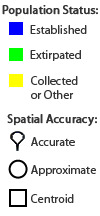
This map only depicts Great Lakes introductions.
|
|
Great Lakes Nonindigenous Occurrences:
Stephanodiscus subtilis was recorded for the first time in Lake Michigan in 1946.
Table 1. Great Lakes region nonindigenous occurrences, the earliest and latest observations in each state/province, and the tally and names of HUCs with observations†. Names and dates are hyperlinked to their relevant specimen records. The list of references for all nonindigenous occurrences of Stephanodiscus subtilis are found here.
Table last updated 6/4/2026
† Populations may not be currently present.
Ecology:
Stephanodiscus subtilis most typically occurs at maximum abundance in disturbed littoral regions, river mouths, and harbors of the Great Lakes in eutrophic and frequently chloride-contaminated, slightly brackish habitats. It is known to respond positively to phosphorus enrichment, or, if phosphorus and nitrogen are not limiting, to the addition of trace minerals. Maximum abundance in the Great Lakes probably occurs at temperatures around 18–19°C and never below 9°C, generally in early summer.
Great Lakes Means of Introduction:
Stephanodiscus subtilis was very likely introduced to the Great Lakes basin in ballast water (Mills et al. 1993).
Great Lakes Status:
Widespread, overwintering and reproducing. Not reported for Lake Superior. Abundance in Lake Michigan was very high in the 1960s (Millie and Lowe 1983, Mills et al. 1993, Stoermer et al. 1975, Stoermer et al. 1978, Stoermer and Ladewski 1976, Stoermer and Yang 1970, Tarapchak and Stoermer 1976).
Great Lakes Impacts:
Summary of species impacts derived from literature review. Click on an icon to find out more...
| Environmental | Socioeconomic | Beneficial |
|
|
| | | |
There is little or no evidence to support that Stephanodiscus subtilis has significant environmental impacts in the Great Lakes.
Stephanodiscus subtilis has been recorded as an abundant diatom taxon in Lake Erie and Lake Ontario during summer and early fall blooms (Mille and Lowe 1983). However, the specific impact of these blooms on native species was not investigated.
There is little or no evidence to support that Stephanodiscus subtilis has significant socio-economic impacts in the Great Lakes.
The distribution of S. subtilis has been primarily nearshore areas or eutrophic waters with a considerable amount of chloride contamination, but it does not itself cause a reduction in water quality (Stoermer and Yang 1970).
There is little or no evidence to support that Stephanodiscus subtilis has significant beneficial effects in the Great Lakes.
Stephanodiscus subtilis may serve as an indicator of poor water quality (Stoermer and Yang 1970).
Management:
Regulations
| Jurisdiction | Regulation | Law | Description | Date Effective |
| Illinois | Other | 515 ILCS 5/20-90 | This species is not on the Illinois Aquatic Life Approved Species List and if it is not otherwise native to Illinois it is illegal to be imported or possessed alive without a permit. | 7/9/2015 |
Note: Table last updated 7/5/2022. Check federal, state, and local regulations for the most up-to-date information.
Control
Chemical
Stephanodiscus subtilis occurs primarily in eutrophic waters with elevated chloride levels (Millie and Lowe 1983). The reduction of pollution and nutrient run-off could decrease the viable habitat for S. subtilis.
Note: Check state/provincial and local regulations for the most up-to-date information regarding permits for control methods. Follow all label instructions.
Remarks:
Within Eurasia, S. subtilis occurs in many regions of the Volga and Dnieper river basins of the former USSR. It is unclear if it is endemic to these areas or not. It may have been present there before it was first recorded in the 1960s and 1970s, but previous investigators had assigned it to a different taxon. This species is known from other areas of Eurasia such as Sweden, the North Sea, and Dutch rivers (Kuzmin et al. 1970, Kuzmin and Okhapkin 1979, Vinogradskaya and Bereza 1974).
References
(click for full reference list)
Author:
Kipp, R.M., M. McCarthy, and A. Fusaro
Contributing Agencies:


Revision Date:
5/2/2025
Citation for this information:
U.S. Geological Survey, 2026, Stephanodiscus subtilis (Van Goor) A. Cleve, 1951: Nonindigenous Aquatic Species Database, Gainesville, FL, and NOAA Great Lakes Aquatic Nonindigenous Species Information System, Ann Arbor, MI, https://nas.er.usgs.gov/queries/GreatLakes/FactSheet.aspx?Species_ID=1698, Revision Date: 5/2/2025, Access Date: 6/5/2026
This information is preliminary or provisional and is subject to revision. It is being provided to meet the need for timely best science. The information has not received final approval by the U.S. Geological Survey (USGS) and is provided on the condition that neither the USGS nor the U.S. Government shall be held liable for any damages resulting from the authorized or unauthorized use of the information.