Piscirickettsia cf. salmonis
Common Name:
Muskie pox
Synonyms and Other Names:
Known in salmonids as piscirickettsiosis, salmon rickettsia syndrome, salmonid rickettsial septicemia, or SRS
PLO in agency reports indicates 'piscirickettsia-like-organism' which may be this species as well.
Identification:
P. salmonis are aerobic Gram-negative bacteria occurring intracellularly in fish, primarily salmonids. The bacteria are usually coccoid (but sometimes occur in paired rods or in rings), fastidious (with very specific growth requirements), and non-motile (Mauel and Miller 2002; Fryer and Hedrick 2003). P. salmonis bacteria isolated from Muskellunge (Esox masquinongy) in Lake St. Clair only occur as curved rods and rings (Michigan DNR 2007).
P. salmonis in salmonids can result in anemia, kidney necrosis, enlarged spleen, hemorrhages, nodules or crater-form lesions in the liver, dark coloration, skin lesions, lack of appetite, anorexia, and lethargic swimming activity. Symptoms vary in different populations and some fish display no external symptoms at all (Mauel and Miller 2002; Fryer and Hedrick 2003; Rise et al. 2004). In Lake St. Clair, infected Muskellunge can exhibit red skin lesions (Michigan DNR 2007).
Size:
P. salmonis is 0.5-1.5 µm in diameter (Fryer and Hedrick 2003).
Native Range:
Unknown. The geographic range of P. salmonis could be broad. It could be native to marine environments, including parts of the Pacific and Atlantic oceans; however, some of the marine regions in which it now occurs could constitute introductions (Fryer and Hedrick 2003).
|
|
|
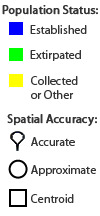
This map only depicts Great Lakes introductions.
|
|
Great Lakes Nonindigenous Occurrences:
Piscirickettsia cf. salmonis was first detected in the Great Lakes from Muskellunge (Esox masquinongy) in Lake St. Clair in May 2002 (MDNR 2004).
Table 1. Great Lakes region nonindigenous occurrences, the earliest and latest observations in each state/province, and the tally and names of HUCs with observations†. Names and dates are hyperlinked to their relevant specimen records. The list of references for all nonindigenous occurrences of Piscirickettsia cf. salmonis are found here.
Table last updated 6/17/2026
† Populations may not be currently present.
Ecology:
Habitat: P. salmonis causes mortality in salmonids, killing millions of hatchery farmed fish each year. As for many diseases that naturally occur in the wild, infection becomes more severe in crowded aquaculture settings. Coho Salmon (Oncorhynchus kisutch) are highly susceptible while Atlantic Salmon (Salmo salar) are less susceptible. P. salmonis has also been reported in Rainbow Trout (O. mykiss), Cherry Salmon (O. masou), Chinook Salmon (O. tschwaytscha), and Pink Salmon (O. gorbuscha), and can probably infect all salmonids (Mauel and Fryer 2001; Mauel and Miller 2002; Fryer and Hedrick 2003; Birkbeck et al. 2004; Rise et al. 2004).
The PLO (piscirickettsia-like organism) infection of Muskellunge (Esox masquinongy) in Lake St. Clair is unique, given that it occurred in wild non-salmonid fish. Other fish affected by P. salmonis and similar organisms have typically been cultured and most have been species that spend at least part of their life cycle in marine environments.
In addition to the occurrence in freshwater Muskellunge in Lake St. Clair, PLOs have also been found in: Blue-eyed Plecostomus (Panaque suttoni), a tropical freshwater fish shipped from Columbia to the USA (Khoo et al. 1995); Seabass (Dicentrarchus labrax) in the Mediterranean Sea (Comps et al. 1996; Athanassopoulou et al. 1999; McCarthy et al. 2005); White Sea Bass (Atractoscion nobilis) off the coast of southern California (Chen et al. 1999; Arkush et al. 2005; Arkush et al. 2006); Puffers (Tetrodon fahaka) from the Nile River in Egypt (Mauel and Miller 2002); Dragonets (Callionymus lyra) from coastal Wales (Mauel and Miller 2002); Tilapia (Oreochromis mossambicus and Sarotherodon melanotheron) in Taiwan, Jamaica, Indonesia, Florida, California, and Hawaii (Chern and Chao 1994; Mauel and Miller 2002); and in Groupers (Epinephelus melanostigma) in Taiwan (Chen et al. 2000).
P. salmonis is inactive above 20°C and replication is optimal at 15–18°C. It survives better in saltwater than in freshwater, remaining infective for up to 14 days in the former but quickly becoming unstable in the latter (Smith et al. 1999; Mauel and Miller 2002; Fryer and Hedrick 2003; Larenas et al. 2003; Mauel et al. 2003; Smith et al. 2004).
Food Web:
P. salmonis is a bacteria feeding on its host fish.
Life History:
P. salmonis survives and replicates asexually through fission in the membrane-bound vacuoles inside the cytoplasm of host fish cells. The genome consists of one large circular chromosome and 3-4 plasmids. Plasmids can be transferred laterally among P. salmonis individuals, allowing genetic recombination.
P. salmonis has not been isolated from gametes, suggesting vertical transmission does not occur (Thomas and Faisal 2009). It can rarely be passed from adult to young and is likely passed more frequently from adult to adult, entering through the skin or gills. Entry via the intestines (consuming an infected fish) has also been reported (Rozas-Serri 2022). From points of entry, P. salmonis quickly moves to infect internal organs.
In addition to primary infection sites in the internal organs, P. salmonis can avoid the host immune response by infecting lysosomes within macrophages and leukocytes (Perez-Stuardo et al. 2019). These sites within the immune system become a ‘beachhead’ for re-infection of the internal organs.
Great Lakes Means of Introduction:
Unknown. Likely introduced with a stocked host fish.
Great Lakes Status:
Cryptogenic. Piscirickettsia cf. salmonis infections have been limited in the Great Lakes to Muskellunge (Esox masquinongy) and Yellow Perch (Perca flavescens) from Lake St. Clair (Hartig 2006, Thomas and Faisal 2009, Haska 2015), but infected a large percentage of those populations (80% of Muskellunge and 57% of Yellow Perch in Lakes St. Clair 2004-2007 (Thomas and Faisal 2009). Analysis of the two isolates from Muskellunge and Yellow Perch indicate both are identical (Thomas and Faisal 2009) but distinct from those responsible for salmonid infections elsewhere. Piscirickettsia-like organisms (PLO) have been reported more recently and more broadly, but it is unclear whether these are the same species (Phelps, Pers. Comm., 2025).
Great Lakes Impacts:
Summary of species impacts derived from literature review. Click on an icon to find out more...
| Environmental | Socioeconomic |
|
| | |
Piscirickettsia cf. salmonis has a moderate environmental impact in the Great Lakes.
Piscirickettsia cf. salmonis infections have been limited in the Great Lakes to Muskellunge (Esox masquinongy) and Yellow Perch (Perca flavescens) from Lake St. Clair (Hartig 2006, Thomas and Faisal 2009, MDNR 2004). The bacterium was detected in all of the fish sampled (n=26) from Lake St. Clair during a large Muskellunge die-off in 2003. Piscirickettsia cf. salmonis infection rates in Lake St. Clair Muskellunge have been found to be over 80 percent in fish larger than 1,000 mm and or older than 8 years (2004-2007; Thomas and Faisal 2009). Piscirickettsia cf. salmonis has also been isolated from Yellow Perch from Lake St. Clair with infection rates as high as 57 percent. However, surveys of P. cf. salmonis-infected waters in the Great Lakes do not indicate substantial negative impacts on native fish populations (MDNR 2004, WDNR 2012).
Piscirickettsia cf. salmonis infections can result in anemia, kidney necrosis, an enlarged spleen, hemorrhaging, nodules or crater-form lesions in the liver, skin lesions, anorexia, and lethargy (Fryer and Hedrick 2003, Mauel and Miller 2002, Rise et al. 2004). Because of this, infected fish are more susceptible to predation (Lafferty and Morris 1996). There is little or no evidence to support that Piscirickettsia cf. salmonis has significant socio-economic impacts in the Great Lakes.
While impacts to the sport fishing industry by P. cf. salmonis have not yet been realized, such effects could be significant. For example, recreational fishing on Lake St. Clair can generate $23 million annually (Thomas and Faisal 2009). Piscirickettsia cf. salmonis infections in cultured Atlantic Salmon (Salmo salar) from the Pacific and Atlantic coasts of Canada have led to population mortality levels of up to 15% (Evelyn 1992, Olsen et al. 1993, Rodger and Drinan 1993). However, no such infections have been realized in Great Lakes Atlantic Salmon. Atlantic salmon are considered less susceptible to infection and mortality; in contrast, Coho Salmon (Oncorhynchus kisutch), Rainbow Trout (O. mykiss), and Chinook Salmon (O. tschwaytscha) are more susceptible (Birkbeck et al. 2004, Fryer and Hedrick 2003, Mauel and Fryer 2001, Mauel and Miller 2002, Rise et al. 2004). Infections in non-native salmonids have not been reported in the Great Lakes.
There is little or no evidence to support that Piscirickettsia cf. salmonis has significant beneficial effects in the Great Lakes.
Management:
Regulations (pertaining to the Great Lakes)
Piscirickettsia salmonis is listed as a provisional pathogen by the Great Lakes Fishery Commission. If found in the wild it should be reported to the Great Lakes Fish Health Committee Chair. Risk assessment is recommended before using as broodstock. If detected in a hatchery, a risk assessment should be used to determine whether it should be transferred or stocked. Action should be taken to minimize spread.
| Jurisdiction | Regulation | Law | Description | Date Effective |
| Illinois | Other | 515 ILCS 5/20-90 | This species is not on the Illinois Aquatic Life Approved Species List and if it is not otherwise native to Illinois it is illegal to be imported or possessed alive without a permit. | 7/9/2015 |
Note: Check federal, state/provincial, and local regulations for the most up-to-date information.
Control
Control methods are focused on treatment of aquaculture and hatchery stocks, options for wild populations are extremely limited.
Biological
Vaccines derived from inactivated P. cf. salmonis bacterins are considered ineffective against the bacterium. Commercial vaccines are dominated by bacterin, recombinant, and attenuated live bacterial vaccines, administered primarily in water-in-oil emulsions (Rozas-Serri 2022). Vaccines have not been fully effective, even in hatchery/aquaculture settings.
Physical
Culling is effective at preventing horizontal transmission of P. cf. salmonis (Torenzo et al. 2005).
Chemical
Epoetin Alfa can reduce mortality rates in P. cf. salmonis infected Pacific Salmon (Torenzo et al. 2005). Dietary supplements, including selenium, may improve fish resistance to P. salmonis (Perez-Valenzuela et al. 2021). Iron deprivation generates a protective response in infected fish reducing cell damage and bacterial load (Rozas-Serri 2022). All commonly used aquaculture disinfectants are considered effective against Piscirickettsia spp. (Corbeil and Crane2009, Fryer et al. 1990, Fryer et al. 1992); paracetic acid was particularly effective (Muniesa et al 2019). Antimicrobial agents used to treat P. salmonis include oxolinic acid, flumequin (Corbeil and Crane 2009, Guardabassi and Courvalin 2006, Todar 2008) and quillaja saponin extracts (Cortes et al 2023). Antibiotics such as florfenicol are commonly administered in feed (San Martin, et al. 2019). Antibiotic resistance is rising, in part due to underdosing; experimental treatments at lower doses of florfenicol resulted in increased biofilm formation, potentially creating a larger reservoir of resistant bacteria (Oliver et al 2023).
Other
Establishment of Muskellunge fingerling index surveys may help monitor trends in spawning success and or fingerling survival (Thomas and Faisal 2009).
Note: Check state/provincial and local regulations for the most up-to-date information regarding permits for control methods. Follow all label instructions.
References
(click for full reference list)
Other Resources:
Author:
Kipp, R.M., A.K.Bogdanoff, A. Fusaro and R. Sturtevant.
Contributing Agencies:


Revision Date:
9/3/2025
Citation for this information:
U.S. Geological Survey, 2026, Piscirickettsia cf. salmonis: Nonindigenous Aquatic Species Database, Gainesville, FL, and NOAA Great Lakes Aquatic Nonindigenous Species Information System, Ann Arbor, MI, https://nas.er.usgs.gov/queries/GreatLakes/FactSheet.aspx?Species_ID=2658, Revision Date: 9/3/2025, Access Date: 6/17/2026
This information is preliminary or provisional and is subject to revision. It is being provided to meet the need for timely best science. The information has not received final approval by the U.S. Geological Survey (USGS) and is provided on the condition that neither the USGS nor the U.S. Government shall be held liable for any damages resulting from the authorized or unauthorized use of the information.