Schmidtea polychroa
(Schmidt, 1861)
Common Name:
A flatworm
Synonyms and Other Names:
Dugesia polychroa, Dugesia lugubris, Planaria polychroa, and Planaria lugubris
Identification:
This uniform to irregularly pigmented brown flatworm exhibits a rounded to somewhat triangular head that narrows slightly at the neck. The two eyes are located close to the anterior end and spaced further apart than in the North American native Girardia (formerly Dugesia) tigrina. Posterior to the eyes there are two unpigmented auricular sensory organs near the lateral margins that barely protrude from the body and are not especially pointed. The single pharynx is completely white. Cocoons are brown, round, and occur on a stock. (Kenk 1972; Pennak 1989; Wienzierl et al. 1998) Average length in a population varies between 4.5 and 10 mm depending on the time of year but maximum size can reach 20 mm (Reynoldson and Davies 1970; Kenk 1972; Boddington and Mettrick 1974).
Size:
can reach 20 mm
Native Range:
Schmidtea polychroa is primarily found in western Europe. However, its Palearctic range encompasses all of Europe, northern Asia, and northern Africa within the Mediterranean basin (de Vries 1985; Mills et al. 1993).
|
|
|
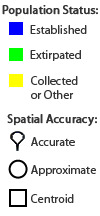
This map only depicts Great Lakes introductions.
|
|
Great Lakes Nonindigenous Occurrences:
Schmidtea polychroa occurred for the first time within the Great Lakes basin in Lake Ontario in 1968 (Ball 1969; Mills et al. 1993). The species is also reported from Lake Champlain (Marsden and Hauser 2009) and the St. Lawrence River (Rink 2018).
Table 1. Great Lakes region nonindigenous occurrences, the earliest and latest observations in each state/province, and the tally and names of HUCs with observations†. Names and dates are hyperlinked to their relevant specimen records. The list of references for all nonindigenous occurrences of Schmidtea polychroa are found here.
Table last updated 6/4/2026
† Populations may not be currently present.
Ecology:
HABITAT:
Schmidtea polychroa typically occurs in littoral zones, especially in rocky regions of productive lakes. In The Netherlands it is only found in waters above pH of 6.0. It rarely occurs in waters of chlorinity above 2‰ and cannot survive permanently in salinities of 3.8‰ and more, although chlorinity up to 6.6‰ can be tolerated for short periods of time. S. polychroa is relatively thermophilic and requires temperatures of 10–23ºC to complete a full life cycle. Its ability to tolerate increased salt concentrations decreases as temperature increases. It requires water temperatures of 10ºC or more for egg case production and does not grow in water temperatures below 5ºC (Reynoldson et al. 1965; Reynoldson and Davies 1970; Boddington and Mettrick 1974; Van der Velde et al. 1986; Seaby et al. 1996). Distribution of S. polychroa in Toronto Harbour, Canada is limited mostly by pollution (Boddington and Mettrick 1974; Reynoldson 1977; Bladon and Calow 1987). In cleaner areas densities can reach up to 2200 individuals per m2. This flatworm is predominantly, but not exclusively, nocturnal (Lombardo et al. 2011). FOOD WEB:
In this Toronto Harbour S. polychroa feeds predominantly on tubificid oligochaetes and supplements its diet with gastropods, isopods, and amphipods (Boddington and Mettrick 1974; Reynoldson 1977; Bladon and Calow 1987). In some British habitats this flatworm mainly consumes gastropods, supplemented by amphipods, asellids, and sometimes chironomids. Differences in relative contribution of food items between British populations and North American ones are probably related to prey availability and competition with other predators. In British habitats, competition with other triclads and leeches is very common (Reynoldson and Davies 1970; Boddington and Mettrick 1974; Reynoldson and Piearce 1979; Seaby et al. 1996).
LIFE HISTORY:
S. polychroa is hermaphroditic. Different lineages of: a) diploid sexual individuals; and b) polyploid, pseudogamous, parthenogenetic individuals exist. In the latter type of lineage, reproduction occurs when unfertilized eggs develop. Sperm is still required to trigger initial egg development, but genetic material from the sperm is not incorporated. Interbreeding between the two different types of lineages sometimes occurs when sperm produced by parthenogens fertilizes sexual individuals. When copulations take place, both individuals involved transfer and receive sperm. Self fertilization does not occur (Beukeboom et al. 1996; Peters et al. 1996; Weinzierl et al. 1998). S. polychroa can also reproduce by fission, when the animal is divided, each portion regenerates the missing parts.
S. polychroa is iteroparous, reproducing many times in a lifetime. In the field, each adult in established populations produces around 0–8 young in a breeding season, but with unlimited food and little competition, each adult can produce around 30– 45 young. Populations in Toronto Harbour, Canada remain low over winter; expand rapidly in spring and summer; peak in August; and then decline. The breeding season in this locality is around 10 weeks long (Boddington and Mettrick 1974; Reynoldson 1977; Bladon and Calow 1987).
Great Lakes Means of Introduction:
Schmidtea polychroa was very likely introduced to North America with ballast (Ball 1969; Mills et al. 1993).
Great Lakes Status:
Uncertain. Likely overwintering and reproducing in Lake Ontario and possibly Lake Erie, but collections rarely resolve the taxonomy sufficiently to distinguish this species from the native Girardia tigrina.
Great Lakes Impacts:
Summary of species impacts derived from literature review. Click on an icon to find out more...
There is little or no evidence to suggest Schmidtea polychroa has significant environmental impacts in the Great Lakes.
Great Lakes native organisms consumed by Schmidtea polychroa include tubificids, gastropods, amphipods, and isopods (Boddington and Mettrick 1974). Throughout much of its distribution in North America, S. polychroa feeds primarily on oligochaetes (Boddington and Mettrick 1974), while the native Girardia tigrina is believed to feed exclusively on gastropods (Reynoldson 1974). However, in Toronto Harbour, Ontario, S. polychroa and G. tigrina are found to coexist; the latter is found at lower densities, suggesting potential intra-specific competition between the triclads (Boddington and Mettrick 1974).
There is little or no evidence to suggest Schmidtea polychroa has significant socio-economic impacts in the Great Lakes.
There is little or no evidence to suggest Schmidtea polychroa has significant beneficial effects in the Great Lakes.
Planarians have been used in medicinal and scientific research in topics including, but not limited to, genomics (Alvarado and Newark 1999), stem cells (Newark and Alvarado 2000, Reddien and Alvarado 2004), and cancer (Oviedo et al. 2008), as well as for modeling morphogenesis, restoration of pattern and polarity, control of tissue proportions, and tissue homeostasis (Salo et al. 2009).
Management:
Regulations (pertaining to the Great Lakes region)
| Jurisdiction | Regulation | Law | Description | Date Effective |
| Illinois | Other | 515 ILCS 5/20-90 | This species is not on the Illinois Aquatic Life Approved Species List and if it is not otherwise native to Illinois it is illegal to be imported or possessed alive without a permit. | 7/9/2015 |
Note: Check federal, state/provincial, and local regulations for the most up-to-date information.
Control
There are no known control methods for this species.
Note: Check state/provincial and local regulations for the most up-to-date information regarding permits for control methods. Follow all label instructions.
Remarks:
In the Great Lakes, flatworms benefit from changes in substrate due to increased interstitial space and increased biodeposition provided by introduced mussels in the genus Dreissena (Ricciardi et al. 1997).
References
(click for full reference list)
Author:
Kipp, R.M., A.K.Bogdanoff, and A. Fusaro.
Contributing Agencies:


Revision Date:
9/17/2025
Citation for this information:
U.S. Geological Survey, 2026, Schmidtea polychroa (Schmidt, 1861): Nonindigenous Aquatic Species Database, Gainesville, FL, and NOAA Great Lakes Aquatic Nonindigenous Species Information System, Ann Arbor, MI, https://nas.er.usgs.gov/queries/GreatLakes/FactSheet.aspx?Species_ID=2359, Revision Date: 9/17/2025, Access Date: 6/4/2026
This information is preliminary or provisional and is subject to revision. It is being provided to meet the need for timely best science. The information has not received final approval by the U.S. Geological Survey (USGS) and is provided on the condition that neither the USGS nor the U.S. Government shall be held liable for any damages resulting from the authorized or unauthorized use of the information.