Salix alba
L.
Common Name:
Golden willow
Synonyms and Other Names:
Salix vitellina L., Salix alba spp. caerulea (Sm.) Rech. f., Salix alba spp. vitellina (L.) Arcang., Salix alba var. alba L., Salix alba var. caerulea (Sm.) Sm., Salix alba var. vitellina (L.) Stokes, Salix alba var. calva G. Mey., golden willow, weeping willow, white willow
Identification:
S. alba is a medium-sized to large deciduous tree growing up to 10-30 m tall, with a trunk up to 1 m diameter and an irregular, often leaning crown. The bark is grey-brown, deeply fissured in older trees. The shoots in the typical species are grey-brown to green-brown. The leaves are paler than most other willows, due to a covering of very fine silky white hairs, particularly on the underside; they are 5-10 cm long and 0.5-1.5 cm wide. The flowers are produced in catkins in early spring, and pollinated by insects. It is dioecious, with male and female catkins on separate trees; the male catkins are 4–5 cm long, the female catkins 3–4 cm long at pollination, lengthening as the fruit matures. When mature in mid summer, the female catkins comprise numerous small (4 mm) capsules each containing numerous minute seeds embedded in white down which aids wind dispersal.
Size:
10-30m tall
Native Range:
Native to Europe and western and central Asia.
|
|
|
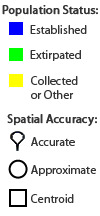
This map only depicts Great Lakes introductions.
|
|
Great Lakes Nonindigenous Occurrences:
Widespread in the USA and the Great Lakes states, including IL, IN, MI, MN, NY, OH, PA, and WI). Widespread in the Great Lakes region by 1886.
Table 1. Great Lakes region nonindigenous occurrences, the earliest and latest observations in each state/province, and the tally and names of HUCs with observations†. Names and dates are hyperlinked to their relevant specimen records. The list of references for all nonindigenous occurrences of Salix alba are found here.
Table last updated 6/6/2026
† Populations may not be currently present.
Ecology:
S. alba prefers moist soil and tolerate wet sites, and is pH adaptable. It is often in landscapes in the form of its weeping cultivars. It blooms from mid-spring to early summer. It is fast-growing, but relatively short-lived, being susceptible to several diseases, including watermark disease caused by the bacterium Brenneria salicis and willow anthracnose, caused by the fungus Marssonina salicicola. These diseases can be a serious problem on trees grown for timber or ornament.
Like most willows, it tolerates very moist soil but also creates litter problems in the form of twigs. These fast-growing trees are usually injured in ice and wind storms.
Great Lakes Means of Introduction:
Deliberate release. Cultivated for ornamental use and harvest of salicylic acid.
Great Lakes Status:
Widespread, overwintering and reproducing.
Great Lakes Impacts:
Summary of species impacts derived from literature review. Click on an icon to find out more...
Current research on the environmental impact of Salix alba in the Great Lakes is inadequate to support proper assessment.
Changes in the composition of insects and other aquatic invertebrates were associated with the presence of these willows, as well as increased water temperatures (GLIFWC, 2017). Salix alba is susceptible to many diseases and parasites. The degree to which it may serve as a vector of disease into to related species is unknown. Salix alba will hybridize with other willows. For example, it hybridizes with S. fragilis, producing S. × rubens Schrank, which is intermediate in character or showing some of each species (e.g., the serrations of one with the pubescence or capsules of the other). This hybrid appears to be relatively frequent and collections apparently intermediate or at least not assignable to either S. alba or S. fragilis have been seen from several counties in Michigan” (Reznicek et al 2011). The degree to hybridization effects native willows is unknown - Salix amygdaloides, Salix bebbiana, salix humilis, salix lucida, are all native to the Great Lakes are a deemed to have cultural significance (USDA), Salix serissima and Salix syrticola are endangered in Indiana.
There is little or no evidence to support that Salix alba has significant socioeconomic impacts in the Great Lakes.
Salix alba has a high benficial impact in the Great Lakes.
This willow is cultivated as a source of salicyclic acid (a component of aspirin), for willow bark (natural medicine), for its soft elastic wood (commonly used in basketmaking and other crafts), for fiber (papermaking), in the production of gun powder, tanning leather, and other purposes. This species is commonly used as a landscape plant, but native alternatives are available. This species has been investigated for potential use in pytoremediation of iron cyanide (Yu et al 2006). This species provides riparian habitat for many species of birds and insects. Along with native willows, this species can be an important food source for many species of caterpillars.
Management:
Regulations (pertaining to the Great Lakes)
In 2011, the Great Lakes Indian Fish & Wildlife Commission ranked S. alba to be a low priority for regulation and control (Falck et al 2012). There are no known federal or state (within the Great Lakes region) regulations for this species. Note: Check federal, state/provincial, and local regulations for the most up-to-date information.
Control
Biological
To our knowledge, no research into possible biological control organisms for this willow has been attempted in North America or anywhere else. Candidates for insect control are generally not sufficiently specific to avoid damage to native willows.
Physical
Like most river trees, willows resprout vigorously from cut stumps, and will usually grow back into a tree eventually. Repeated cutting of new stump shoots can eventually kill the trees. But given their large root systems, cutting would presumably be needed to be done several times per growing season for several years in order to starve the roots. Mowing or weed-whipping might be useful for seedlings. (GLIFWC 2013). Small seedlings can be hand-pulled, while larger trees may require a weed wrench or machinery to remove the root systems.
Chemical
Given willows’ tendency to resprout from the roots, multiple applications will likely be needed for control.
The nonselective herbicide glyphosate (available commercially as "Roundup" and "Rodeo") is commonly used for treating woody invasives such as crack willows. Tryclopyr (Garlon 3A or equivalent amine formulation) is also effective against broadleaf and woody plants, and has the advantage of leaving grasses and sedges intact. Recently Roundup has been shown to be highly toxic to both adult frogs and toads and their tadpoles, probably due to the surfactant (polyethoxylated tallowamine, or POEA) in this glyphosate formulation (Relyea 2005). Because of this and other as yet unknown effects of various herbicide formulations on the environment, herbicide should be applied as precisely as possible and only when needed, using only the amount needed to get the job done. Any attempt to control crack willows or other invasive plants in aquatic habitats must be done using Rodeo or other herbicides formulated for use over water. Permits are required for herbicide application over water in many states, including Wisconsin, Michigan and Minnesota. (GLIFWC 2013).
Triclopyr amine is best used on young willows (seedlings) that are actively growing. 2,4-D LV ester can be applied when leaves are fully developed and growing (amendable to aerial application). Metsulfuron is used on fully leafed-out brush.
Note: Check state/provincial and local regulations for the most up-to-date information regarding permits for control methods. Follow all label instructions.
Remarks:
This species readily forms natural hybrids with the crack willow Salix fragilis, the hybrid being named Salix × rubens Schrank. Synonyms: Salix vitellina
References
(click for full reference list)
Author:
Cao, L, Lower, E., and L. Berent
Contributing Agencies:


Revision Date:
4/30/2026
Citation for this information:
U.S. Geological Survey, 2026, Salix alba L.: Nonindigenous Aquatic Species Database, Gainesville, FL, and NOAA Great Lakes Aquatic Nonindigenous Species Information System, Ann Arbor, MI, https://nas.er.usgs.gov/queries/GreatLakes/FactSheet.aspx?Species_ID=2687, Revision Date: 4/30/2026, Access Date: 6/7/2026
This information is preliminary or provisional and is subject to revision. It is being provided to meet the need for timely best science. The information has not received final approval by the U.S. Geological Survey (USGS) and is provided on the condition that neither the USGS nor the U.S. Government shall be held liable for any damages resulting from the authorized or unauthorized use of the information.