Ichthyocotylurus pileatus
(Rudolphi, 1802)
Common Name:
A digenean fluke
Synonyms and Other Names:
Tetracotyle diminuta
Identification:
This digenetic trematode species occurs in metacercarial form (encysted larvae in cases) in host fish. These larvae have an oral sucker, pharynx, pseudosucker (depression surrounded by thick edges), and a definite ventral sucker (Mattheis and Odening 1980).
Size:
Metacercariae are typically 150-430 µm by 130-340 µm in size, and encapsulated cysts can measure 285-565 µm by 270-530 µm - However, in one study, adult worms measured 115 x 70 µm
Native Range:
Native to the Ponto-Caspian (U.S.EPA 2008) and Black Sea basin (Pronin et al. 1997b).
|
|
|
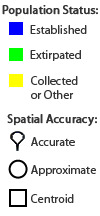
This map only depicts Great Lakes introductions.
|
|
Great Lakes Nonindigenous Occurrences:
Great Lakes occurrences of Ichthyocotylurus pileatus have been realized for nearly a century, dating back to 1927-1929 from Trout-Perch (Percopsis omiscomaycus) in western Lake Erie (Bangham and Hunter 1939).
Table 1. Great Lakes region nonindigenous occurrences, the earliest and latest observations in each state/province, and the tally and names of HUCs with observations†. Names and dates are hyperlinked to their relevant specimen records. The list of references for all nonindigenous occurrences of Ichthyocotylurus pileatus are found here.
Table last updated 6/4/2026
† Populations may not be currently present.
Ecology:
Habitat: This digenean fluke is very common on many fish species in its native range. Metacercariae occurred in the mesentery and body cavity of Round Gobies from Lake St. Clair and ruffe from Lake Superior (Pronin et al. 1997a; Pronin et al. 1997b; U.S. Department of the Interior 1993). This parasite is most often found in the heart and/or kidneys (Stewart and Bernier 1999). Life Cycle: Indirect with at least one intermediate host, typically a snail or clam. The intermediate host for I. pileatus has not been identified.
Great Lakes Means of Introduction:
Very likely introduced with host fishes in ballast water (U.S. Department of the Interior 1993).
Great Lakes Status:
Widespread, overwintering and reproducing.
Great Lakes Impacts:
Summary of species impacts derived from literature review. Click on an icon to find out more...
| Environmental | Socioeconomic | Beneficial |
|
|
| | | |
Ichthyocotylurus pileatus has a moderate environmental impact in the Great Lakes. In the Great Lakes, larval or immature I. pileatus have been detected in Yellow Perch (Perca flavescens) at 37.7% prevalence (582 fish examined) with light (1-9 parasites/host) to moderate (10-49 parasites/host) infections (Dechtiar and Christie 1988, Dechtiar and Lawrie 1988, Dechtiar and Nepszy 1988); Walleye (Sander vitreus) at 47% prevalence (15 fish examined) with moderate infections (Dechtiar and Lawrie 1988); and Trout-Perch (Percopsis omiscomaycus) at 46.5% prevalence (>39 fish examined) with light infections (Bangham and Hunter 1939, Dechtiar and Christie 1988). The larval form of I. pileatus has also been found in piscivorous birds of Lake Superior and the Lake St. Clair system (Muzzall and Whelan 2011).
There is little or no evidence to support that Ichthyocotylurus pileatus has significant socio-economic impacts in the Great Lakes.
Recreationally valuable Great Lakes species susceptible to I. pileatus infections include Yellow Perch, Walleye, and Trout-Perch; however, impacts to this sector have not been realized.
There is little or no evidence to support that Ichthyocotylurus pileatus has significant beneficial effects in the Great Lakes.
Non-native Great Lakes species found harboring larval or immature I. pileatus include Eurasian Ruffe (Gymnocephalus cernuus) (Pronin et al. 1998) and Round Goby (Neogobius melanostomus) (Pronin et al. 1997b). Ichthyocotylurus pileatus is unlikely to have significant effects in terms of regulating the Round Goby population in the Great Lakes (Pronin et al. 1997b). It is possible, however, that its presence in combination with that of other more prevalent parasites in Eurasian Ruffe increases this species’ susceptibility to the negative effects of anoxia (Pronin et al. 1997a).
Management:
Regulations (pertaining to the Great Lakes)
| Jurisdiction | Regulation | Law | Description | Date Effective |
| Illinois | Other | 515 ILCS 5/20-90 | This species is not on the Illinois Aquatic Life Approved Species List and if it is not otherwise native to Illinois it is illegal to be imported or possessed alive without a permit. | 7/9/2015 |
Note: Check federal, state/provincial, and local regulations for the most up-to-date information.
Control
There are no known control methods for this species.
Note: Check state/provincial and local regulations for the most up-to-date information regarding permits for control methods. Follow all label instructions.
References
(click for full reference list)
Author:
Kipp, R.M., A.K.Bogdanoff, and A. Fusaro.
Contributing Agencies:


Revision Date:
9/2/2025
Citation for this information:
U.S. Geological Survey, 2026, Ichthyocotylurus pileatus (Rudolphi, 1802): Nonindigenous Aquatic Species Database, Gainesville, FL, and NOAA Great Lakes Aquatic Nonindigenous Species Information System, Ann Arbor, MI, https://nas.er.usgs.gov/queries/GreatLakes/FactSheet.aspx?Species_ID=2720, Revision Date: 9/2/2025, Access Date: 6/4/2026
This information is preliminary or provisional and is subject to revision. It is being provided to meet the need for timely best science. The information has not received final approval by the U.S. Geological Survey (USGS) and is provided on the condition that neither the USGS nor the U.S. Government shall be held liable for any damages resulting from the authorized or unauthorized use of the information.