Novirhabdovirus sp. genotype IV sublineage b
Common Name:
Viral Hemorrhagic Septicemia Virus (VHSV-IVb)
Synonyms and Other Names:
Identification:
VHS is an RNA virus with a bullet-shaped morphology typical of rhabdoviruses and a 11–12 kb nucleotide genome encoding five structural proteins. Viral particles are 170-180 nm in length and 60-70 nm in width (Skall et al. 2005; Elsayad et al. 2006). A classification based on sequences of N- and G-genes reveals four major genotypic groups that correspond to the geographical distribution of the virus: one group includes isolates from European inland waters and northern marine coastal areas, a second group is composed of marine isolates from the Baltic Sea, a third group comprises isolates from the North Sea, and a fourth group comprises North American isolates. Thus far, the virus has been found in Europe, North America, Japan and Korea (Nishizawa et al. 2002; Skall et al. 2005). Based on a comparison of the gene sequences of all North American VHS isolates, Elsayad et al. (2006) propose that the VHS isolate obtained from a muskellunge in Lake St. Clair constitutes a distinct sublineage of the North American genotype that likely originated on the east coast of North America. The clinical signs of VHS differ depending on the course of infection. In the latent manifestation of the disease, some mortality may occur and fish become hyperactive, sometimes displaying nervous symptoms such as twisting of the body and behavior that involves swimming erratically in circles or in a corkscrew pattern (CFSPH 2003). Conversely, some carriers of the virus may show no symptoms at all (Dopazo et al. 2002). Histopathological changes occur in the liver, kidneys, spleen and skeletal muscle (McAllister 1990); the kidney and spleen appear to be the organs most often targeted by VHS virus (Brudeseth et al. 2002). In the acute form of the disease, fish become lethargic, dark and anemic, with bulging eyes, congested kidneys, mottled liver, and with hemorrhage in the eyes, skin, gills, fin bases, skeletal muscle and viscera (McAllister 1990). Mortality is very high and the disease is short-lived (CFSPH 2003). In the chronic form of the disease, mortality is low and all the symptoms are similar to the acute form, except that hemorrhaging is not common; instead, the liver, spleen and kidneys experience an accumulation of fluid such that the body becomes bloated and the liver and kidneys become very light in color (McAllister 1990). Survivors of infection can be carriers of the virus throughout the rest of their lives.
Size:
approximately 170-180 nm long and 60-70 nm wide (Elsayad et al. 2006; McAllister 1990).
Native Range:
Indigenous to eastern and western Europe, Japan, and the Pacific coast (from California to Alaska) and Atlantic coast of North America. Some evidence suggests that the European strains of VHS are native to the Atlantic Ocean. It is generally believed that all strains of VHS are derived from a common marine ancestor (Skall et al. 2005).
Based on a comparison of the gene sequences of all North American VHS isolates, Elsayad et al. (2006) propose that the VHS isolate obtained from a muskellunge in Lake St. Clair constitutes a distinct sublineage of the North American genotype (designated North American genotype IVb) that likely originated on the east coast of North America.
|
|
|
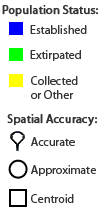
This map only depicts Great Lakes introductions.
|
|
Great Lakes Nonindigenous Occurrences:
This novel sublineage of the North American genotype IV was first isolated from Muskellunge (Esox masquinongy) caught in the northwest part of Lake St. Clair (Elsayad et al. 2006). VHS has subsequently become established throughout much of the Great Lakes region.
Table 1. Great Lakes region nonindigenous occurrences, the earliest and latest observations in each state/province, and the tally and names of HUCs with observations†. Names and dates are hyperlinked to their relevant specimen records. The list of references for all nonindigenous occurrences of Novirhabdovirus sp. genotype IV sublineage b are found here.
Table last updated 2/23/2026
† Populations may not be currently present.
* HUCs are not listed for areas where the observation(s) cannot be approximated to a HUC (e.g. state centroids or Canadian provinces).
Ecology:
Habitat VHS occurs in both marine and freshwater environments. It requires an incubation period of approximately 7 to 15 days, depending on water temperature and distribution modeling suggests a suitable temperature of 1 to 18 °C based on occurrence data and temperature data from satellite imagery (CFSPH 2003; Escobar et al. 2017). The optimum replication temperature is 14–15°C, whereas replication is low at 6°C and almost nonexistent at 20°C (De Kinkelin et al. 1980; Bernard et al. 1983; McAllister 1990). Fish mortality from VHS is greatest at 3–12°C and is very rare above 15°C (McAllister 1990). The virus becomes inactive after 24 hours at 20°C in water, but can persist for five days at 4°C in water (CFSPH 2003). VHS does not tolerate exposure to pH levels lower than 2.4 or higher than 12.2, the optimum pH for replication is 7.4–7.8 (CFSPH 2003; McAllister 1990). The virus becomes inactivated in ether, chloroform, glycerol, formalin, sodium hypochlorite, sodium hydroxide, iodophors, UV radiation, or by desiccation.
Food Web
Fishes are susceptible to infection at any age, see OIE (2019) for a list of susceptible species worldwide and Kim and Faisal (2010) for susceptible species in the Great Lakes region. Juvenile fish are generally more susceptible than adults. Experiments have recorded infection after contact with infected fish and after immersion in infected water (McAllister 1990). There is evidence of infections transferred between farmed and free-living fishes in European inland waters and coastal areas in British Columbia (Stone et al. 1997; Skall et al. 2005; Garver et al. 2015). The mortality rate for infected fish varies between 20% and 80%, depending on environmental conditions, and has reached 100% in trout fry (CFSPH 2003).
Life History
VHSV viral cycle requires entry into cells of the host, replication utilizing the host cell’s internal mechanisms, and subsequent exit from the host back into the aquatic environment. The spread of VHSV depends upon efficient vertical and horizontal transmission routes (Escobar et al. 2018). VHS is transmitted to juvenile and adult fish most often via urine and sex products that enter a fish through secondary gill lamellae, possibly through fin bases or via wounds; it cannot enter eggs and infect fish before hatching but can be transmitted on the surface of the egg (McAllister 1990; Brudeseth et al. 2002; CFSPH 2003; Harmache et al. 2006). The VHS virus can survive outside of a host for weeks at optimum temperatures and persists for long periods of time in the bottom of culture ponds, potentially in invertebrates (CFSPH 2003). Individuals that survive a VHS outbreak or those that are asymptomatic can act as lifelong viral reservoirs (He et al. 2021).
Great Lakes Means of Introduction:
It is not known how VHS was initially introduced to the Great Lakes–St. Lawrence River system; however, genetic evidence suggests that the virus originated from the Atlantic coast of North America, possibly via transport in ballast water or infected migratory fishes (Elsayad et al. 2006). Recent study indicates that VHS distributions are not related to shipping or boating activity (Bain et al 2010). Aquaculture activities are implicated in the spread of the virus (Skall et al. 2005; Fisheries Research Services 2006). The potential for transport with bait fish (reviewed by Goodwin et al. 2004) is demonstrated by the virus' recovery in cell culture from frozen Pacific Herring (Clupea pallasi) after two freeze/thaw cycles in a conventional freezer (Meyers et al. 1994). Waterfowl might also play a role in transmitting the virus (Peters & Neukirch 1986). It appears that once VHSV is established in a region the virus will become widespread, hosted by fish without disease symptoms, and capable of persistence at low but detectable levels (Bain et al 2010).
Great Lakes Status:
The North American strain of VHS virus is widespread in the Great Lakes region. It is present in Lakes Ontario, Erie, St. Clair, Huron, Michigan, and Superior. VHS has also been reported in the St. Lawrence River and inland lakes in New York, Michigan, and Wisconsin (Elsayad et al. 2006, MNDR 2010, Whelan 2009, Wren and Lee 2006, USDA 2006).
Great Lakes Impacts:
Summary of species impacts derived from literature review. Click on an icon to find out more...
| Environmental | Socioeconomic | Beneficial |
|
|
| | | |
Novirhabdovirus sp. VHSV-IVb has a high environmental impact in the Great Lakes. VHS is listed as a World Organization for Animal Health (OIE) reportable disease for aquatic animals (OIE 2012) and is also listed as a reportable disease in Canada (CFIA 2012). VHSV-IVb has the potential to infect a wide range of fish species (Kim and Faisal 2010a) with clinical signs such as body twisting and erratic swimming (CFSPH 2003). Infected fish may be more susceptible to predation (Lafferty and Morris 1996), which could result in indirect effects on the food web and ecosystem. Die-offs of apex predators such as muskellunge and northern pike may have severe impacts on the Great Lakes food web.
Novirhabdovirus sp. VHSV-IVb has a high socio-economic impact in the Great Lakes.
Humans are not susceptible to VHS and there is no evidence that the virus can be transferred to humans by consuming infected fish (PFBC 2011). Increased regulations (see Management) have limited the scope of operations for those in the bait/live fish industry and have cost a substantial amount of additional time and money to fulfill testing and certification requirements. Despite the wide host range of the virus, effects on commercial and recreational fisheries related to die-offs have been relatively mild in the Great Lakes (Focus on Fish Health 2010).
There is little or no evidence to support that Novirhabdovirus sp. VHSV-IVb has significant beneficial effects in the Great Lakes.
VHS has caused die-offs of non-native species in the Great Lakes, including Round Goby (Neogobius melanostomus) (Wren and Lee 2006). In 2008, the first recorded die-off of Round Goby occurred in Lake Michigan, although observed signs of the virus had been documented in Lake Michigan in 2007 (Focus on Fish Health 2010). Die-offs of Common Carp (Cyprinus carpio) have been observed in Lake Ontario (Whelan 2009).
Management:
Regulations (pertaining to the Great Lakes) - International:
- International movement of VHS-susceptible species from the two infected Canadian provinces to the United States is permitted if the shipment meets certain requirements and is imported under an APHIS permit for direct slaughter, or during catch and release fishing activities (USDA and APHIS 2008).
- US Federal:
- A U.S. Federal Order aims to prevent the spread of VHS into aquaculture facilities by restricting the interstate movement and importation of live fish of VHS-susceptible species. This order was updated in September 2008 to allow for movement of VHS-susceptible species from the eight states bordering the Great Lakes, given that the fish are: “(1) Intended for human consumption; (2) transported to a State-inspected slaughter facility that discharges waste water into a municipal sewage system that includes waste water disinfection, or disposes of waste water in a non-discharging settling pond or a settling pond that disinfects according to State and Federal requirements, and renders or composts offal, including carcasses; and (3) accompanied by a valid VS Form 1-27 issued by an APHIS area office if not tested for VHS.” See the Federal Order for more information on interstate movement, testing requirements, import restrictions, and other details pertaining to Federal VHS regulation.
- Canadian Federal:
- VHS is a reportable disease in Canada, anyone that suspects VHS in their fish is required by law to notify the Canadian Food Inspection Agency (CFIA). See the Government of Canada’s Viral Hemorrhagic Septicemia (VHS) webpage for further information.
- US States:
- Illinois: It is unlawful to “(1) import VHS-susceptible species into the State of Illinois without a VHS-Susceptible Species Permit issued by the Department; (2) stock VHS-susceptible species into waters of the State without securing permission from Department fish health authorities, or unless an FHIR is on file with the Department; (3) remove live VHS-susceptible species from the waters where legally taken without first securing permission from Department fish health authorities, unless an FHIR is on file with the Department, or as provided in Section 875.30; (4) remove natural water from waters of the State via bait bucket, livewell, baitwell, bilge, etc., or any other method without first securing permission from Department fish health authorities, unless an FHIR is on file with the Department, or as provided in Section 875.30; (5) remove any watercraft, boat, boat trailer or other equipment from waters of the State without emptying and draining any bait bucket, livewell, baitwell, bilge, etc., or any other compartment capable of holding natural waters; and (6) use wild-trapped fishes as bait within the State of Illinois, other than in the waters where they were legally taken.” See Ill. Admin. Code tit. 17, § 875 for further information.
- Indiana: The importation of VHS-susceptible species into the state is regulated under 345 Ind. Admin. Code 1-3-31.5, a pre-entry permit is required to import live VHS-susceptible species originating from a VHS-affected or at-risk region. Additionally, the movement of VHS-susceptible species is restricted and requires negative VHS tests if they originate from a VHS-affected or at-risk region. Refer to the code for permit details, exceptions, and testing standards.
- Michigan: The importation and movement of VHS-susceptible species is regulated under the Fisheries Disease Control Order 245.21. A permit is required from the Michigan Department of Agriculture and Rural Development (MDARD) to import aquaculture species, this permit requires a fish health certificate or a certificate of veterinary inspection in accordance with the Michigan Department of Natural Resources (MDNR) Fisheries Health Guidance Document. A stocking permit is required from the MDNR to import for stocking fish in public waters or for use as baitfish under Mich. Comp. Laws Ann. § 324.48735.
- Minnesota: As stated in Minn. Stat. Ann. § 17.4985, “a licensee may not import aquatic life into the state, transport aquatic life within the state, or stock waters of the state with aquatic life without first obtaining a bill of lading or transportation permit from the commissioner, with disease certification, if applicable.” The use of VHS-susceptible species as bait is restricted under Minn. R. 6262.0576, which states “A person shall not take, possess, or use restricted bait in water bodies other than Lake Superior or its tributaries below the posted boundaries unless: (1) the restricted bait is being used on the same body of water where caught and while still on that water body. The restricted bait must not be transported off the water body, alive or dead, for any purpose; (2) the water body where the restricted bait originated is listed on the department's website as having no presence of VHS in all species in the last year or the person has in the person's immediate possession: (a) a valid fish health certification for the source water body showing no presence of VHS in the last year; or (b) labeling as specified in subpart 3, item B, for frozen restricted bait; (3) the restricted bait is preserved and labeled according to part 6262.0577 or as further prescribed by the commissioner in a permit. The labeling must be in the person's immediate possession; (4) the restricted bait was purchased from a licensed minnow dealer or minnow retailer; or (5) cisco or smelt are being transported dead or on ice for personal consumption only.” State law prohibits the import of live, frozen, or processed bait from known waters where VHS has been identified as being present unless the bait has been processed to inactivate VHS (Minn. Stat. Ann. § 97C.341).
- New York: “No person may place live fish into the water bodies of the State, or possess, sell, offer for sale, barter, import or transport fish for purposes of placing them into water bodies of the State, unless such fish are accompanied by a fish health certification report issued within the previous 12 months, except: (1) in the marine and coastal district, as defined in Environmental Conservation Law, section 13-0103; or (2) pursuant to permit issued by the department in its discretion; or (3) where a water body is contiguous with waters of another state or Province, live fish, except bait fish, taken from those waters outside of New York State, may be transported on the contiguous water across the state or Province boundary and may be released in the New York water body” (N.Y. Comp. Codes R. & Regs. tit. 6, § 188.1).
- Ohio: A VHS Proclamation by Ohio’s Department of Agriculture, effective January 1, 2020, prohibits the intra-state transportation, sale, or distribution of 28 fish species susceptible to VHS in the affected region of Northern Ohio. To import fish, viable eggs, or sperm of the family Salmonidae or Salmonidae hybrids or the species or hybrids of the species listed in appendix A of 901:1-17-13 (list of fish susceptible to VHS); a fish importation permit issued by Ohio Department of Agriculture, a fish health inspection and testing report signed by a certified fish health inspector or veterinarian, and a transportation permit issued by the Ohio Department of Natural Resources is required.
- Pennsylvania: The Department of Agriculture issued a VHS Quarantine Order August 30th, 2008 to establish guidelines for the production, movement, and importation of VHS-susceptible species. This order establishes a quarantine for VHS susceptible species for the following states, which have been designated by USDA-APHIS as being either affected by VHS or as being at risk of being affected by VHS (Quarantined VHS-Affected or VHS At-Risk States): Illinois, Indiana, Michigan, Minnesota, New York, Ohio and Wisconsin. This Interstate Quarantine will also extend to any State that is subsequently designated a VHS-Affected or VHS At-Risk State by USDA-APHIS. Regulations state that “it is unlawful to transport or cause the transportation of VHS-susceptible species of fish into Pennsylvania from a VHS-affected or VHS-at risk state” without VHS testing and certification. The sale of VHS-susceptible species is restricted under 58 Pa. Code § 63.51 and “It is unlawful to sell VHS-susceptible species of fish from the portion of the Lake Erie watershed in this Commonwealth in other watersheds of this Commonwealth except in accordance with § 69.3(e) (relating to transportation, introduction and sale of VHS-susceptible species of fish out of the Lake Erie watershed). It unlawful to sell in this Commonwealth VHS-susceptible species of fish from a VHS-affected or VHS-at risk state, unless the following conditions are met: (1) The sale meets the requirements of 30 Pa.C.S. § 2507 (relating to sale of certain fish, reptiles and amphibians prohibited). (2) The fish are from a group of fish certified as having tested negative for VHS or are from an artificial propagation facility certified as having tested negative for VHS in accordance with the testing protocols adopted by the Pennsylvania Department of Agriculture and approved by the Commission. Persons selling these fish shall have in their possession, and present upon the request of an officer authorized to enforce the code, either a copy of the fish health certification reports for all VHS-susceptible fish kept at the place of sale or a copy of the fish health certification report for the artificial propagation facility if the fish are from a facility certified as having tested negative for VHS.”
- Wisconsin: Under Wis. Stat. Ann. § 95.60, an import permit is required: if the fish or fish eggs originate from the wild and are to be delivered to a registered fish farm; if the fish or fish eggs originate from any source out of state and are to be released into a body of water that is not registered as a fish farm (e.g., private pond or waters of the state). Under Wis. Admin. Code § 10.62, no permit is required if: live fish from out of state fish farm to WI fish farm with health certificate ornamental fish; live fish held in enclosed buildings for educational purpose; fish for processing/retail food/consumption; imported by DNR from out of state fish farm to instate fish farm; non-VHS susceptible fish for bait. Importation of non-native fish species requires a permit from the Wisconsin Department of Natural Resources.
- Canadian Provinces:
- Ontario: The Ministry of Natural Resources and Forestry has implemented management zones to help slow the spread of VHS. Commercial bait operators are prohibited from moving live baitfish out of the VHS Management Zone and live or dead bait in or out of the Lake Simcoe Management Zone. Salmon and trout eggs may be collected from virus-positive waters only if eggs are disinfected according to the Ministry’s protocol. Walleye spawn collection is permitted as long as the fish are stocked back into virus-positive waters. Fish and eggs are permitted to be stocked in waters that are not virus-positive only if the facilities are certified VHS free. See Ontario’s Viral hemorrhagic septicemia (VHS) webpage for more information about the management of VHS and consult the Ontario Fishing Regulations Summary for guidelines regarding the use of bait.
Note: Check federal, state/provincial, and local regulations for the most up-to-date information.
Control
Biological
There are currently no widely utilized biological control methods for VHS infection. However, research conducted in recent years has highlighted potential biological control options. Extract from the algae Ecklonia cava inhibited VHSV in laboratory studies and enhanced the antiviral immune response for exposed species (Yang et al. 2018). The antiviral probiotic Bacillus subtilis has been found to prevent VHSV infection, fish pre-treated with B.subtilis showed no cytopathic effects and suggests this probiotic has potential applications in the aquaculture industry as an antiviral agent (Han et al. 2021). Reverse genetics have been applied to create a recombinant strain of VHSV with an amino acid change, juvenile fish exposed to the genetically modified strain had increased survival and protection from wild-type VHSV challenge (Bailon et al. 2017). Additionally, genetically engineered and DNA vaccines developed in recent years have been shown to provide high levels of protection from VHS challenge (Millard et al. 2017; Kim and Kim 2019).
Physical
VHS physical control options include the treatment of water with ultraviolet-C (UVC) light irradiation (200-280 nm wavelength), blue LED light (405-nm LED at 20-40 mu mol·m-2·s-1), heat (>15°C), exposure to pH levels lower than 2.5 or higher than 12.2, desiccation of tanks or equipment, minimization of stressors, cessation of water flow to adjacent waterways, and establishment of quarantines (Warren 1983; McAllister 1990; CHSPH 2003; Ho et al. 2020). Furthermore, exposure to VHS can be prevented through use of spring water, specific pathogen free (SPF) stock, and separate cultivation of salmonids and flatfish (CFSPH 2003).
Chemical
The VHS virus is sensitive to ether, chloroform, glycerol, formalin, iodophor, sodium hydroxide, and sodium hypochlorite, which can be used as disinfectants (CFSPH 2003, McAllister 1990). Disinfection of live wells and other contaminated equipment can be accomplished with a 10% household bleach/water solution (e.g., 100 ml of household bleach to 900 ml of water) or a disinfectant with active ingredients Potassium Peroxymonosulfate and Sodium Chloride (OMNR 2021). Waste water should be discarded at least 30 meters away from any water body. Ribavirin and ivermectin are two antiviral medications that have shown to help control VHSV infections (Baek et al. 2023). Alpha-Lipoic acid has been shown to suppress VHS replication by inducing antiviral gene expression and reduce oxidative stress (Zhang et al. 2021). The use of a polyinosinic-polycytidylic acid poly (I:C)-potentiated vaccine, a squalene-aluminum hydroxide adjuvanted vaccine, and immersion vaccines have all demonstrated potential to increase fish survival and provide protection against VHS challenge in aquaculture (Hwang et al. 2017; Chun et al. 2021; Dar et al. 2021).
Other
Anglers and pond owners can help prevent the spread of VHS. As with other hitchhiking aquatic species, boaters and anglers are encouraged to clean and disinfect their gear (Bakal 2012), as well as to completely drain bilges and live wells before moving between bodies of water (OMNR 2021). Anglers can ensure the safe disposal of their fish by dumping bait buckets at least 30 meters from any waterway and dispose of fish waste or unwanted bait in the garbage and not waterways. After fishing in a waterbody known to contain VHS, anglers are advised to inspect their equipment for mud, plants, and aquatic animals. Pond owners can help limit the spread of VHS by not releasing fish into public waters and not collecting fish from a natural water body to stock their aquarium or water garden (OMNR 2021).
The U.S. Fish and Wildlife Service recommends implementation of the International Hazard Analysis and Critical Control Point (HACCP) planning standard to prevent the spread of VHS (Bakal 2012). VHS should be reported to Area Veterinarians in Charge (AVIC) or state veterinarians immediately upon diagnosis or recognition of the disease. Fish health surveillance programs and fallowing are also useful methods of control (CFSPH 2003).
Note: Check state/provincial and local regulations for the most up-to-date information regarding permits for control methods. Follow all label instructions.
Remarks:
A U.S. Federal Order aims to prevent the spread of VHS into aquaculture facilities by restricting the interstate movement and importation of live fish of VHS-susceptible species
References
(click for full reference list)
Author:
Kipp, R.M., A. Ricciardi, A.K. Bogdanoff, A. Fusaro, and C. Shelly
Contributing Agencies:


Revision Date:
9/30/2025
Citation for this information:
Kipp, R.M., A. Ricciardi, A.K. Bogdanoff, A. Fusaro, and C. Shelly, 2026, Novirhabdovirus sp. genotype IV sublineage b: U.S. Geological Survey, Nonindigenous Aquatic Species Database, Gainesville, FL, and NOAA Great Lakes Aquatic Nonindigenous Species Information System, Ann Arbor, MI, https://nas.er.usgs.gov/queries/greatLakes/FactSheet.aspx?Species_ID=2656, Revision Date: 9/30/2025, Access Date: 2/23/2026
This information is preliminary or provisional and is subject to revision. It is being provided to meet the need for timely best science. The information has not received final approval by the U.S. Geological Survey (USGS) and is provided on the condition that neither the USGS nor the U.S. Government shall be held liable for any damages resulting from the authorized or unauthorized use of the information.