Cherax quadricarinatus
(von Martens, 1868)
Common Name:
Australian redclaw crayfish
Synonyms and Other Names:
Queensland Redclaw Crayfish, Tropical Blue Crayfish, Freshwater Blueclaw Crayfish, North Queensland Yabby, Blue Lobster, Redclaw Crayfish
Identification:
Cherax quadricarinatus is a large bodied crayfish with a blue-green to green color with red and maroon highlights. Adult males have a soft, fleshy, bright red patch on the outer margin of the major chelae. This species also has four long and distinct carinae (ridges) on the dorsal surface of the cephalon (Coughran and Leckie 2007).
Size:
Cherax quadricarinatus may reach a total length of about 250 mm (9.8 inches) and weigh up to 600 grams (21.2 oz) (Ahyong and Yeo 2007)
Native Range:
Cherax quadricarinatus is native to Australia, and can be found in freshwater creeks and water bodies in tropical Queensland, the Northern Territory and southeastern Papua New Guinea (Coughran and Leckie 2007).
|
|
|
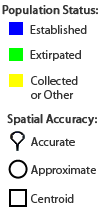
This map only depicts Great Lakes introductions.
|
|
Great Lakes Nonindigenous Occurrences:
This species is not currently in the Great Lakes region but may be elsewhere in the US. See the point map for details.
Table 1. Great Lakes region nonindigenous occurrences, the earliest and latest observations in each state/province, and the tally and names of HUCs with observations†. Names and dates are hyperlinked to their relevant specimen records. The list of references for all nonindigenous occurrences of Cherax quadricarinatus are found here.
Table last updated 6/9/2026
† Populations may not be currently present.
Ecology:
Cherax quadricarinatus is tolerant of a wide variety of habitats can be found in tropical and subtropical climates coastal streams and freshwater environments, with a preference for the slower moving upper reaches of rivers as well as lakes and lagoons (Wingfield 2002). Cherax quadricarinatus is a non-burrowing species that is tolerant of high temperatures and relatively low dissolved oxygen concentrations (Masser and Rouse 1997). Similar to North American crayfish species, Cherax quadricarinatus is an omnivorous detritivore, feeding on plant and animal decay. However, unlike native crayfish, the species does not rely on environmental cues for seasonal breeding, such as temperature changes, but instead, can breed all year, with multiple broods being produced in water temperatures above 75 °F. Cherax quadricarinatus reaches sexual maturity before one year of age, with females producing up to 1000 eggs and 3-5 broods during a breeding season (Masser and Rouse 1997).
Cherax quadricarinatus exihibits the traits of both r- and K- selected species, with its life history including high numbers of offspring with low mortality rates and large body sizes, likely promoting the species' successful colonization in many areas outside of its native range (Beatty 2005).
Great Lakes Means of Introduction:
Cherax quadricarinatus has a high probability of introduction to the Great Lakes (Confidence level: Moderate). Potential pathway(s) of introduction: unauthorized intentional release.
Cherax quadricarinatus is not currently established in any waters that are connected to the Great Lakes Basin. Within the United States, it is established in Texas and Puerto Rico, with an ambiguous population reported in California (Morningstar et al. 2020; Sanjar et al. 2023). They are not known to hitchhike or foul boats. This species is cultured in Puerto Rico and available for purchase from culture facilities in Florida. Auburn University has had an aquaculture colony of C. quadricarinatus (Patillo 2010). However, C. quadricarinatus is a popular aquarium species that is readily available through online retailers.
Great Lakes Status:
Cherax quadricarinatus has a low probability of establishment if introduced to the Great Lakes (Confidence level: High). While tolerant of high temperatures and low dissolved oxygen (Masser and Rouse 1997), C. quadricarinatus is immobilized at temperatures below 14°C and reproduction only occurs at temperatures above 23°C (Oficialdegui 2022; Patillo 2010). This species struggles to reproduce and grow in environments with winter water temperatures below 10°C, making overwintering unlikely in the Great Lakes Basin (Arias and Torralba-Burrial 2019).? C. quadricarinatus is considered a reasonably non-aggressive, non-territorial freshwater crayfish species that does not compete well with other species occupying similar niches (USFWS 2012; Jones 2005). Climate match is poor for the Great Lakes region and distribution models do not predict establishment in or near the Great Lakes (Larson and Olden 2012; USFWS 2012).
Great Lakes Impacts:
Summary of species impacts derived from literature review. Click on an icon to find out more...
| Environmental | Socioeconomic |
|
| | |
Cherax quadricarinatus has the potential for high environmental impact if introduced to the Great Lakes. Cherax quadricarinatus is a known carrier of viruses, bacteria, fungi, parasites (Austin et al., 2009), as well as crayfish plague (Australian Blue Yabby Aquaculture, 2010). They were shown to significantly decrease the size, but not survival, of a native crayfish species in a mesocosm experiment at Auburn University (Patillo, 2010). Ahyong and Yeo (2007) note that they have the potential to negatively affect native species through predation, direct competition, or habitat modification.
There is little or no evidence to support that Cherax quadricarinatus has the potential for significant socio-economic impacts if introduced to the Great Lakes.
It has not been reported that Cherax quadricarinatus poses a threat to human health or water quality. There is no evidence that this species negatively impacts infrastructure, economic sectors, recreational activities and associated tourism, or the aesthetic appeal of the areas it inhabits.
Cherax quadricarinatus has the potential for moderate beneficial impacts if introduced to the Great Lakes.
Cherax quadricarinatus has commercial value as an aquaculture species in Australia, Argentina, Ecuador, Mexico, Puerto Rico, and Uruguay; however they are less popular than other freshwater invertebrate aquaculture species, so the overall economic contribution of this activity is small (FAO, 2011). It is not used as a biological control agent of other nuisance species, and they are not known to improve water quality. They are not commonly employed as a recreational fishery.
Management:
Regulations (pertaining to the Great Lakes region) - Pennsylvania restricts the sale, possession, introduction and transportation of all crayfish species (44 Pa.B. 4177).
- Crayfish species not native to Michigan waters, may not be possessed live or used alive for bait, on any waters of this state whether those waters are public or private (FO-249.15).
- Cherax quadricarinatus is not on the Illinois Aquatic Life Approved Species List and if it is not otherwise native to Illinois it is illegal to be imported or possessed alive without a permit (515 ILCS 5/20-90).
- Minnesota prohibits the transportation of live native and invasive crayfish from one waterbody to another within the state is prohibited, except by permit issued by the DNR. Live crayfish or crayfish eggs may not be imported without a permit issued by the DNR (Minnesota DNR).
- Live crayfish may not be used as bait in Wisconsin except on the Mississippi River. (Wis. Admin. Code NR § 40.07; Wis. Admin. Code NR § 19.27).
- For a summary of crayfish regulations in the Great Lakes region, see the “Great Lakes Crayfish Regulation” report produced by the National Sea Grant Law Center.
Note: Check federal, state/provincial, and local regulations for the most up-to-date information.
Control
Biological
Although there is no specific data on biological control for redclaw crayfish (Cherax quadricarinatus), insights from other crayfish species can be applied. Restricting the harvest of native crayfish predators has been shown to significantly reduce invasive crayfish populations when done in conjunction with intensive trapping (Hein et al. 2007; Perales et al. 2021). In the Great Lakes region, smallmouth bass (Micropterus dolomieu) and rock bass (Ambloplites rupestris) are known crayfish predators and good candidates to control unwanted crayfish populations. Fish predation has been shown to be effective in combination with other control methods (Hein et al. 2007; Aquiloni et al. 2010).
Physical
The use of physical barriers and diversions have been reviewed as a method to control non-indigenous crayfish species populations in Europe and America (Gherardi et al. 2011; Kerby et al. 2005). Intensive trapping is a common method used to control crayfish (Moorhouse et al. 2013; Peay 2001). However, trapping has not been found to completely eradicate established crayfish populations (Perales et al. 2021).
Other physical control methods include hand removal or electrofishing, which has seen some success in controlling localize populations (Manfrin et al. 2019).
Chemical
Chemical control methods, such as the application of piscicides and biocides, can be effective, especially in confined habitats or early in an invasion. Cypermethrin, a commonly used piscicide, and pyrethroid insecticides have successfully controlled crayfish in some settings (Hyatt 2004; Gherardi et al. 2011; Lidova et al. 2019). However, these chemicals are costly, may harm non-target organisms, and can be ineffective on a larger scale due to crayfish behaviors like burrowing and climbing out of water (Anastacio et al. 1995). Research is exploring alternative methods, such as carbon dioxide treatments, which have shown promise in enhancing crayfish capture (Smerud et al. 2022).
Other
Manfrin et al. (2019) review innovative techniques for controlling crayfish populations focus on targeted disruptions of reproduction and physiology. Using pheromones as sexual attractants can influence crayfish behavior and control reproductive interactions without affecting native species. Biotechnological methods such as creating monosex populations and employing RNA interference (RNAi) disrupt reproduction through hormonal or genetic manipulation, providing species-specific control with minimal environmental impact . The Sterile Male Release Technique (SMRT) introduces sterile males into populations, effectively reducing reproduction when paired with trapping efforts. Additionally, new autocidal oral delivery systems use microemulsions to deliver host-specific compounds that disrupt physiological functions, offering promising control strategies.
Note: Check state/provincial and local regulations for the most up-to-date information regarding permits for control methods. Follow all label instructions.
Remarks:
Cherax quadricarinatus is in the aquaculture industry in countries such as Belize, China, Indonesia, Israel, Morocco, Panama, Spain, and the United States (Rubino et al. 1990; FAO, 2011-2013).
References
(click for full reference list)
Author:
Daniel, W., Boucher, N., Elgin, A., Shelly, C.
Contributing Agencies:


Revision Date:
12/19/2025
Citation for this information:
U.S. Geological Survey, 2026, Cherax quadricarinatus (von Martens, 1868): Nonindigenous Aquatic Species Database, Gainesville, FL, and NOAA Great Lakes Aquatic Nonindigenous Species Information System, Ann Arbor, MI, https://nas.er.usgs.gov/queries/greatlakes/FactSheet.aspx?Potential=Y&Species_ID=220, Revision Date: 12/19/2025, Access Date: 6/9/2026
This information is preliminary or provisional and is subject to revision. It is being provided to meet the need for timely best science. The information has not received final approval by the U.S. Geological Survey (USGS) and is provided on the condition that neither the USGS nor the U.S. Government shall be held liable for any damages resulting from the authorized or unauthorized use of the information.