Psammonobiotus linearis
Golemansky, 1970
Common Name:
A testate amoeba
Synonyms and Other Names:
Identification:
Amoebas in the family Psammonobiotidae have bilaterally symmetric tests (shells) of organic material covered in haphazardly arranged quartz shards (Golemansky 1974; Nicholls and MacIsaac 2004; Nicholls 2005). The quartz particles in this species are large and polygonal and the test is transparent and colorless. Pseudopods protrude through an opening at one end of the test and are surrounded by a flared, flat collar. P. linearis usually has a conspicuous horn-like extension of its test at the aboral end. The length to width ratio of this species is 2–2.5 (Golemansky 1970; Nicholls and MacIsaac 2004).
Size:
This species averages 28 µm in length, 13 µm width and 13 µm height in the Great Lakes. Specimens from other parts of the world are smaller and are 16–24 µm in length
Native Range:
P. linearis is probably native to the Ponto-Caspian region of Eurasia (Black Sea, Caspian Sea, and Aral Sea basins). Since it was first described from the Black Sea, it has been recorded from the Baltic Sea and the Bay of Biscay prior to being found in the Great Lakes (Nicholls and MacIsaac 2004). Also described from the Chilean Antarctic (Golemansky 2016).
|
|
|
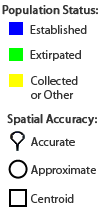
This map only depicts Great Lakes introductions.
|
|
Great Lakes Nonindigenous Occurrences:
P. linearis was first recorded in 2002 from eastern Lake Ontario and from Rondeau Bay, Lake Erie (Nicholls and MacIsaac 2004).
Ecology:
Habitat: Psammonobionts generally occur where interstitial water movement and oxygen supply are adequate (e.g. in beach sand). They attach to sand grains by way of the flat collar that is part of the test. This species has been recorded in salinities of up to 31 ppt in various water bodies (Nicholls and MacIsaac 2004) and at depths of 60 cm in beach sands (Golemansky 1970). Psammonobiotus spp. have also been reported from river plankton (Kiss et al. 2009), though rare and possibly representing animals displaced from normal habitat. A few specimens of P. linearis have also been identified in wet mosses from the River Rezovska, Bulgaria (Davidova 2010), associated with submerged vegetation in the Rabisha Reservoir, Bulgaria (Davidova 2010b) and associated with littoral benthos in Marsh Malak Preslavets, Bulgaria (Davidova 2020) which may indicate the species can adapt to a wider range of habitat types. Food Web: The pseudopods protrude from the oral opening of the test for locomotion and feeding. Testate amoebas feed on bacteria, small algae, fungi and particulate organic matter. Testate amoebae can be preyed on by nematodes and other worms, mites and other microinvertebrates. (Todorov and Bankov 2019)
Life History: Studies in Bulgaria demonstrate a seasonal pattern of abundance, with P. linearis populations peaking in August (Davidova and Vasilev 2013). Life history of this species has not otherwise been studied specifically. Testate amoebae generally reproduce asexually by simple division (binary fission). Daughter cells quickly construct their own test rather than inheriting half the parent test. Some testate amoeba have also been observed to reproduce sexually, but that has not been observed for this genus. Testate amoebae can produce resistant cysts against unfavorable environmental conditions. Cysts are formed within the shell with an additional thick membrane and reduced cell volume. Testate amoebae often seal the shell aperture prior to encysting (Todorov and Bankov 2019).
Great Lakes Means of Introduction:
The most probable vector of introduction to the Great Lakes is ship ballast (Nicholls and MacIsaac 2004).
Great Lakes Status:
Overwintering and reproducing in Lakes Erie and Ontario, though rare relative to the other Psammonobiotus spp. reported for the Great Lakes. This species was not found in surveys of Lakes Superior and Huron; it should be noted that Lake Michigan has not yet been surveyed for this organism (Nicholls and MacIsaac 2004).
Great Lakes Impacts:
Summary of species impacts derived from literature review. Click on an icon to find out more...
There is little or no evidence to support that Psammonobiotus linearis has significant environmental impacts in the Great Lakes.
Compared to abundance in marine beaches, densities of psammobiont testate rhizopods in the Great Lakes are relatively low overall (Nicholls and MacIsaac 2004). While the impacts of P. linearis in the Great Lakes have not yet been studied, testate amoebae tend to prey upon and modify microbial populations, accelerate nutrient cycling, and be consumed by other organisms (e.g., Lousier and Parkinson 1984, Schönborn 1992). Furthermore, selective grazing by testate amoebae may influence microbial community taxonomic composition and metabolic activity (Bonkowski 2004, Sherr et al. 1992). There is little or no evidence to support that Psammonobiotus linearis has significant socio-economic impacts in the Great Lakes.
There is little or no evidence to support that Psammonobiotus linearis has significant beneficial effects in the Great Lakes.
In studies outside the Great Lakes, testate amoebae have been used as indicators of ecosystem condition and function (e.g., Fournier et al. 2012).
Management:
Regulations
| Jurisdiction | Regulation | Law | Description | Date Effective |
| Illinois | Other | 515 ILCS 5/20-90 | This species is not on the Illinois Aquatic Life Approved Species List and if it is not otherwise native to Illinois it is illegal to be imported or possessed alive without a permit. | 7/9/2015 |
Note: Check federal, state/provincial, and local regulations for the most up-to-date information.
Control
There are no known control methods for this species.
Note: Check state/provincial and local regulations for the most up-to-date information regarding permits for control methods. Follow all label instructions.
Remarks:
Individuals found in the Great Lakes display characteristics that differ from those originally described for P. linearis, including greater length and differently shaped test collar (Nicholls and MacIsaac 2004). Given the lack of research effort devoted to testate amoebae to date, this species may have been present in the Great Lakes for many decades prior to its discovery. However, Nicholls and MacIsaac (2004) also remark that the Psammanobiotus species, given their current distribution pattern, may be relatively recent arrivals to the Great Lakes.
References
(click for full reference list)
Author:
Kipp, R.M., A.K.Bogdanoff, and A. Fusaro.
Contributing Agencies:


Revision Date:
9/3/2025
Citation for this information:
Kipp, R.M., A.K.Bogdanoff, and A. Fusaro., 2026, Psammonobiotus linearis Golemansky, 1970: U.S. Geological Survey, Nonindigenous Aquatic Species Database, Gainesville, FL, and NOAA Great Lakes Aquatic Nonindigenous Species Information System, Ann Arbor, MI, https://nas.er.usgs.gov/queries/greatlakes/FactSheet.aspx?Species_ID=2655, Revision Date: 9/3/2025, Access Date: 5/11/2026
This information is preliminary or provisional and is subject to revision. It is being provided to meet the need for timely best science. The information has not received final approval by the U.S. Geological Survey (USGS) and is provided on the condition that neither the USGS nor the U.S. Government shall be held liable for any damages resulting from the authorized or unauthorized use of the information.