Sprivivirus cyprinus
Common Name:
Spring viremia of carp (SVC)
Synonyms and Other Names:
Spring viremia of carp, infectious dropsy of carp, SVC, SVCV, Rhabdovirus carpio, Vesiculovirus carpio
Identification:
Spring viremia of carp (SVC) is a viral disease caused by Sprivivirus cyprinus (SVCV), a bullet-shaped single-strand RNA virus. Described as systemic and acute, this disease is highly contagious. Externally, SVC is identified by bulging eyes, skin hemorrhages, bloated appearance, a darkening of the skin, and vent protrusion. Internally, fluids build up in all organs and the body cavity of the infected fish and there are hemorrhages in the swim bladder as well as inflamed intestines. Fish infected with the disease may appear lethargic, have slowed respiration, and have a loss of equilibrium. Though most prevalent in Common Carp, other members of the Family Cyprinidae (minnow family) are susceptible.
Size:
80 to 180 nm
Native Range:
First diagnosed in Yugoslavia, Rhabdovirus carpio has been identified in Europe, Russia and the Middle East.
|
|
|
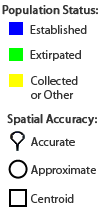
This map only depicts Great Lakes introductions.
|
|
Great Lakes Nonindigenous Occurrences:
The first occurrence of this disease in the United States was from cultivated fish in North Carolina in spring 2002 (Goodwin 2002). That same year, SVCV was isolated from common carp in Calumet Sag Channel, Illinois and Cedar Lake, Wisconsin (CFSPH 2007, Dikkeboom 2004). Subsequent occurrences have been reported in Ohio and Minnesota. Additionally, SVCV has been reported in Hamilton Harbor, Ontario, Canada (CFSPH 2007, Cipriano et al. 2011, Garver et al. 2007, MDNR 2012). The Great Lakes Fish Health Committee (GLFHC 2001 - Pers. comm.) considers this virus to be established in Lake Michigan.
Ecology:
HABITAT - SVC usually occurs in the spring where water temperatures are less than 18°C (peak mortality at 15-17°C) (Abbas et al. 2021). Above 20°C, most infected fish develop immunity and mortality rates fall (Goodwin 2009). Infectious at pH 3-12; freeze-thaw cycles partially inactivate the virus (Ahne et al. 2002). Phelps et al. (2012) suggest that environmental conditions (rapid fluctuations in
temperature, pH, dissolved oxygen, etc.) depress the immune system of host fishes, resulting in increased susceptibility. Common Carp (Cyprinus carpio) is the main species of fish affected, but infections have also been reported in Koi (Cyprinus carpio koi), Crucian Carp (Carassius carassius), Sheatfish (Silurus glanis), Silver Carp (Hypophthalmichthys molithrix), Bighead Carp (Hypophthalmichthys nobilis), Grass Carp (Ctenopharyngodon idella), Goldfish (Carassius auratus), Orfe (Leuciscus idus), Tench (Tinca tinca), Pike-perch (Stizosteidon lucioperca), European Perch (Perca fluviatilis), Northern Pike (Esox lucius), Rainbow trout (Oncorhynchus mykiss), Emerald Shiner (Notropis atherinoides), Largemouth Bass (Micropterus salmoides), and Bluegill (Lepomis macrochirus). Guppy (Lebistes reticulatus), Pumpkinseed (Lepomis gibbosus), Golden Shiner (Notemigonus crysoleucas), Roach (Rutilus rutilus), and Zebra Danios (Danio rerio) have been infected in experiments but infections of these species are not reported in the wild or aquaculture . Fathead minnow (Pimephales promelas) cell lines are used to culture SVC in the laboratory. (Svetlana et al. 2006, Goodwin 2009, Cipriano 2011, Stone et al. 2013)
LIFE HISTORY - Infected fish shed this virus through feces and possibly through urine and gill mucus. The virus enters fish through the gills or can enter through parasites, such as the carp louse or the leech. This parasite can also be transmitted by ingested crustaceans and annelids. The virus has also been found in ovarian fluids, making transmittal though reproduction a potential, however, studies among fry and fingerling fish have shown a lack of outbreaks and most sources consider vertical transmission unlikely (Ahne et al. 2002).
Great Lakes Means of Introduction:
In 2002, SVCV was first reported in U.S. waters at a North Carolina Koi hatchery. This strain was similar to strains isolated from Koi and Goldfish imported from China (Goodwin 2009). Unfortunately, there is evidence that Koi had been distributed from this hatchery to most of the 48 contiguous states before being confirmed with SVCV. The first Common Carp (Cyprinus carpio) die-off of wild fish that tested positive for SVCV occurred in 2002 at Cedar Lake, Wisconsin (Dikkeboom et al. 2004); this strain was identical to the North Carolina type. Perhaps most threatening, the virus was found in Common Carp caught from the Cal-Sag Channel near Calumet, Illinois in 2003. While there was no carp mortality observed, the fish were carriers of SVCV. Infected carp were free to swim from the Cal-Sag Channel into Lake Michigan.
Great Lakes Status:
Overwintering and reproducing at least in Lake Michigan.
Great Lakes Impacts:
Summary of species impacts derived from literature review. Click on an icon to find out more...
| Environmental | Socioeconomic | Beneficial |
|
|
| | | |
Sprivivirus cyprinus has a high environmental impact in the Great Lakes. SVC is listed as a World Organization for Animal Health (OIE) reportable disease for aquatic animals (OIE 2012) and is also listed as a reportable disease in Canada (CFIA 2012). As such, it is automatically assessed as having a high environmental impact in the Great Lakes region. Symptoms of SVC include exophthalmia, darkened coloration, anemia, and hemorrhage in the gills, skin, and eyes as well as abdominal distention, bulging eyes and erratic swimming (Fijan et al. 1971, Abbas et al. 2021). Because of this, infected fish may be more susceptible to predation (Lafferty and Morris 1996). Overall, SVC is currently not believed to be a significant problem in North America (Cipriano et al. 2011). The most susceptible species are not native to the Great Lakes.
Sprivivirus cyprinus has a high socioeconomic impact in the Great Lakes.
SVC has caused a loss of 20% of the US population of cultured carp (Abbas et al. 2021). Response to infection on fish farms can be catastrophic (complete destruction of contaminated stocks - sometimes described as ‘low risk, high consequence’ (Phelps, Pers. Comm. 2025).
There is little or no evidence to support that Sprivivirus cyprinus has significant beneficial effects in the Great Lakes.
SVCV primarily infects Common Carp (Cyprinus carpio), Koi Carp (Cyprinus carpio koi), Grass Carp (Ctenopharyngodon idella), Silver Carp (Hypophthalamicthys molitrix), Bighead Carp (H. nobilis), and Goldfish (Carassius auratus) (CFSPH 2007, OIE 2009) - all of which are non-native in the Great Lakes. Australia has investigated SVC as a potential biocontrol for invasive carp species (Roberts and Tilzey 1997).
Management:
Regulations | Jurisdiction | Regulation | Law | Description | Date Effective |
| Illinois | Other | 515 ILCS 5/20-90 | This species is not on the Illinois Aquatic Life Approved Species List and if it is not otherwise native to Illinois it is illegal to be imported or possessed alive without a permit. | 7/9/2015 |
| Indiana | Other | NA | This species is listed as a species of concern in Indiana, however, thos specific regulations are defined | 9/8/2021 |
SVC is listed as a World Organization for Animal Health (OIE) reportable disease for aquatic animals (OIE 2012) and is also listed as a reportable disease in Canada (CFIA 2012).
Importation of live fish, fertilized eggs, and gametes of SVC-susceptible species including Common Carp (Cyprinus carpio), Koi (C. carpio koi), Grass Carp (Ctenopharyngodon idella), Silver Carp (Hypophthalamicthys molitrix), Bighead Carp (Aristicthys nobilis), Crucian Carp (Carassius carassius), goldfish (Carassius auratus), Tench (Tinca tinca), Orfe (Leuciscus idus), and Sheatfish (Silurus glanis) is permitted, provided they are accompanied by a USDA import permit and a veterinary health certificate (USDA and APHIS 2012).
Note: Check federal, state/provincial, and local regulations for the most up-to-date information.
Control
Biological
Single-stranded and double-stranded RNA injections can provide Rhabdovirus carpio protection for up to three weeks (Aliken et al. 1996, Masytecheva et al. 1995).
Physical
Establishment of quarantines, culling, and stock density reduction during the winter and spring are beneficial management practices to prevent the spread of SVCv (CFPHS 2007). Rhabdovirus carpio is inactivated by UV irradiation (254 nm), gamma irradiation (103 krads), heating to 60°C (140°F) for 30 minutes, and exposure to pH 12 for 10 minutes, or pH 3 for 3 hours (CFSPH 2007,OIE 2009).
Chemical
Disinfection of facilities and equipment will prevent the spread of SVCv in aquaculture (CFPHS 2007). Rhabdovirus carpio is susceptible to oxidizing agents like sodium dodecyl sulphate, non-ionic detergents, and lipid solvents. The virus is inactivated by formalin(3%) for five minutes, chlorine (500 ppm), iodine (0.01%), NaOH (2%) for ten minutes, banzalkonium chloride (100 ppm for 20 minutes), alkyltoluene (350ppm for 20 minutes), chlorhexidine gluconate (100 ppm for 20 minutes), and cresol (200 ppm for 20 minutes) (Ahne and Held 1980, Ahne 1982, CFSPH 2007, Fijan 1999, Kiryu 2007). Methisoprinol may be useful by inhibiting replication of SVCv in vitro. Further testing under culture conditions is necessary (Siwicheki et al 2003).
Note: Check state/provincial and local regulations for the most up-to-date information regarding permits for control methods. Follow all label instructions.
Remarks:
The rhabdovirus family has recently been resolved; Spring viremia of carp was first moved into the Genus Vesiculovirus due to similarities with mammalian vesiculoviruses (Gadd 2013), but more recently moved to Genus Sprivivirus along with Pike fry rhabdovirus (Sprivivirus esox) based on genomic analyses (Stone et al. 2013, Abbas et al. 2021, Walker et al. 2022) and assigned to the subfamily Alpharhabdovirinae along with several other rhabdoviruses of fish and marine mammals. The SVCV is the standardized abbreviation for the species (Walker et al. 2022).
References
(click for full reference list)
Author:
Cao, L. A.K. Bogdanoff, A. Fusaro and R. Sturtevant
Contributing Agencies:


Revision Date:
9/3/2025
Citation for this information:
U.S. Geological Survey, 2026, Sprivivirus cyprinus: Nonindigenous Aquatic Species Database, Gainesville, FL, and NOAA Great Lakes Aquatic Nonindigenous Species Information System, Ann Arbor, MI, https://nas.er.usgs.gov/queries/greatlakes/FactSheet.aspx?Species_ID=2725, Revision Date: 9/3/2025, Access Date: 6/4/2026
This information is preliminary or provisional and is subject to revision. It is being provided to meet the need for timely best science. The information has not received final approval by the U.S. Geological Survey (USGS) and is provided on the condition that neither the USGS nor the U.S. Government shall be held liable for any damages resulting from the authorized or unauthorized use of the information.