Neocaridina davidi
(cherry shrimp)
Crustaceans-Shrimp
Exotic |
|
Common name: cherry shrimp
Synonyms and Other Names: Neocaridina denticulata davidi, Neocaridina denticulata sinensis, Caridina davidi, Neocaridina heteropoda
Taxonomy: available through
www.itis.gov
Identification: Neocaridina davidi is a small freshwater shrimp species. Wild-type individuals exhibit variable coloration, ranging from mostly transparent to greenish brown. In captivity, selective breeding has produced numerous color morphs, including blue, red, yellow, green, and orange (Suen and GiIllett-Kaufman 2020). As the most common pathway of introduction is by aquarium releases, a variety of color morphs have been observed in introduced areas (iNaturalist 2026). This species resembles marine shrimp in general appearance but can be distinguished by its squarer rostrum compared to the more pointed rostrum of marine counterparts (Suen and Gillett-Kaufman 2020).
Size: Body size can reach up to 40 mm (Klotz et al. 2013).
Native Range: Neocaridina davidi is native to southeast Asia including parts of China, Vietnam, Taiwan, and Korea (Schoolman and Ardnt 2018).


|
Alaska |
Hawaii |
Puerto Rico &
Virgin Islands |
Guam Saipan |
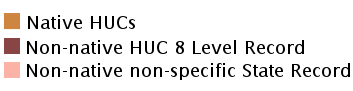
Hydrologic Unit Codes (HUCs) Explained
Interactive maps: Point Distribution Maps
Nonindigenous Occurrences:
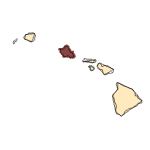
Neocaridina davidi has been established in O’ahu, Hawaii since the 1990s (Englund and Cai 1999). In the continental United States, specimens have been collected from central Florida. Outside the United States, N. davidi has been found throughout Europe, la Réunion, Brazil, Japan and in thermal pools in Canada (Prati et al. 2024; Bochini et al. 2024).
Table 1. States with nonindigenous occurrences, the earliest and latest observations in each state, and the tally and names of HUCs with observations†. Names and dates are hyperlinked to their relevant specimen records. The list of references for all nonindigenous occurrences of Neocaridina davidi are found here.
Table last updated 6/9/2026
† Populations may not be currently present.
Ecology: Neocaridina davidi are habitat generalist capable of occupying diverse environments. Although they prefer higher velocity waters, they have been recorded to colonize slower moving waters such as irrigation ditches and canals (Englund and Cai 1999). They can tolerate hypoxic conditions with low oxygen levels (Prati et al. 2024) and, while primarily a freshwater species, they have been documented to have a high salinity tolerance (Bochini et al. 2024). In both its native and introduced range, N. davidi has been recorded to occur in large numbers, often in the absence of other atyid shrimps (Englund and Cai 1999). This species is an opportunistic omnivore, feeding on whatever is available, including detritus, algae, and meiofauna such as oligochaetes, microcrustaceans, and nematodes (Weber and Traunspurger 2016). Neocaridina davidi are highly fecund, with a clutch size of up to 60 eggs (Pantaleao et al. 2015). Species of the Neocaridina genus do not have a planktonic larval stage but instead exhibit direct development, where females incubate the eggs for 16 to 19 days (Mitsugi et al. 2017; Suen and Gillett-Kaufman 2020). Individuals become sexually mature at around 30 days of age. Their high fecundity, combined with a wide range of environmental tolerances, has contributed to their popularity in the aquarium trade (Klotz et al. 2013).
Means of Introduction: The primary pathway of introduction of this species is through accidental or intentional aquarium releases. They have also been introduced through aquaculture in Slovakia and parts of China. (Englund and Cai 1999; Prati et al. 2024).
Status: They are established on O’ahu, Hawaii (Englund and Cai 1999) and multple individuals have been collected from central Florida.
Impact of Introduction: Neocaridina davidi populations can negatively impact native meiofaunal communities by exerting predation pressure that reduces secondary production as well as the density and biomass of meiofaunal assemblages (Weber and Traunspurger 2016). In Hawaii, Japan, and introduced areas in China, native atyid shrimp species were not observed in areas with populations of N. davidi (Englund and Cai 1999; Onuki and Fuke 2022). In Europe, N. davidi has been observed to host the microsporidian parasite Ecytonucleospora hepatopenaei, and parasite spillover events to Procambarus clarkii have been documented (Prati et al. 2024)
References: (click for full references)
Bochini, G.L., A. dos Santos Rios, J.N. Teles, F.J. Zara, and F.L. Mantelatto. 2024. Confirmed by integrative taxonomy first and unusual occurrence of the exotic shrimp
Neocaridina davidi (Caridea: Atyidae) in Brazil. Boletim do Instituto de Pesca 50: e849. https://doi.org/10.20950/1678-2305/bip.2024.50.e849.
Englund, R.A., and Y. Cai. 1999. The occurrence and description of Neocaridina denticulata sinensis (Kemp, 1918) (Crustacea: Decapoda: Atyidae), a new introduction to the Hawaiian Islands. Bishop Museum Occasional Papers(58):58-65.
Klotz, W., F.W. Miesen, S. Hüllen, and F. Herder. 2013. Two Asian fresh water shrimp species found in a thermally polluted stream system in North Rhine-Westphalia, Germany. Aquatic Invasions 8: 333-339. https://doi.org/10.3391/ai.2013.8.3.09.
Mitsugi ,M., Y. Hisamoto, and H. Suzuki . 2017. An invasive freshwater shrimp of the genus Neocaridina Kubo, 1938 (Decapoda: Caridea: Atyidae) collected from Boso Peninsula, Tateyama City, Chiba Prefecture, eastern Japan. Crustacean Research 46:83–94. https://doi.org/10.18353/crustacea.46.0_83.
Onuki, K. and Y. Fuke. 2022. Rediscovery of a native freshwater shrimp, Neocaridina denticulata, and expansion of an invasive species in and around Lake Biwa, Japan: genetic and morphological approach. Conservation Genetics 23:967–980. https://doi.org/10.1007/s10592-022-01467-1.
Pantaleão, J.A.F., R.A. Gregati, R.C. da Costa, L.S. Lopez-Greco, and M.L. Negreiros-Fransozo. 2015. Post-hatching development of the ornamental 'Red Cherry Shrimp' Neocaridina davidi (Bouvier, 1904) (Crustacea, Caridea, Atyidae) under laboratorial conditions. Aquaculture Research 48: 1–7. https://doi.org/10.1111/are.12903.
Prati, S., D.S. Grabner, K. Hupalo, A. Weiperth, R. Maciaszek, B. Lipták, J. Bojko, F. Bérces, and B. Sures. 2024. Invisible invaders: range expansion of feral Neocaridina davidi offers new opportunities for generalist intracellular parasites. Biological Invasions 26:2499–2523. https://doi.org/10.1007/s10530-024-03324-3.
Schoolman, G. and H. Ardnt. 2018. Population dynamics of the invasive freshwater shrimp Neocaridina davidi in the thermally polluted Gillbach stream (North Rhine-Westphalia, Germany). Limnologica 71:1–7. https://doi.org/10.1016/j.limno.2018.05.001.
Weber, S., and W. Traunspurger. 2016. Influence of the ornamental red cherry shrimp Neocaridina davidi (Bouvier, 1904) on freshwater meiofaunal assemblages. Limnologica 59:155–161. https://doi.org/10.1016/j.limno.2016.06.001.
Other Resources:
https://www.fws.gov/sites/default/files/documents/2025-06/ecological-risk-screening-summary-cherry-shrimp-june-2025.pdf
https://www.inaturalist.org/taxa/1070598-Neocaridina-davidi
https://edis.ifas.ufl.edu/publication/IN1301
Author:
Stratton, L.D.
Revision Date: 2/11/2026
Peer Review Date: 2/11/2026
Citation Information:
U.S. Geological Survey, 2026, Neocaridina davidi (Bouvier, 1904): Nonindigenous Aquatic Species Database, Gainesville, FL, https://nas.er.usgs.gov/queries/FactSheet.aspx?speciesID=2257, Revision Date: 2/11/2026, Peer Review Date: 2/11/2026, Access Date: 6/9/2026
This information is preliminary or provisional and is subject to revision. It is being provided to meet the need for timely best science. The information has not received final approval by the U.S. Geological Survey (USGS) and is provided on the condition that neither the USGS nor the U.S. Government shall be held liable for any damages resulting from the authorized or unauthorized use of the information.