Egeria najas
(narrowleaf anacharis)
Plants
Exotic |
|
Common name: narrowleaf anacharis
Synonyms and Other Names: Anacharis najas (Planchon) Victorin 1931, Elodea najas, narrowleaf egeria
Identification: Dioecious, submerged, fresh-water perennial. Simple, adventitious roots which develop from nodes with lateral branches. Each lateral branch bears at its base two subopposite, scale-like leaves; they are in a median position and the adaxial scale usually carries a bud. This bud usually remains dormant, but it may develop into a new shoot if anchoring roots develop at this particular double node or if the plant is damaged. Elongate, toothed leaves not densely covering the stem except for the apex, frequently recurved, most often in whorls of five. Leaves also possess a single spine at the apex of the leaf which is barely visible. Leaf length ranges from 10-19 mm. Stems lie 0.8 to 1.5 mm in diameter with 1.5 to 10 mm internodal length. Flowers lie about 3 cm above the water surface but when submerged, the petals close, trapping an air bubble which keeps the stamens and stigmas dry. Male flowers number between 2 and 5 in each spathe, with 3 petals that are free, shining white, widely elliptic to orbicular, usually faintly 5-veined, spreading but evanescent, usually appearing somewhat crumpled, both surfaces papillose. Female flowers are very similar to male flowers, except they are generally smaller and number 1 or rarely 2 in each spathe (Cook and Urmi-König 1984). According to Cook and Urmi-König (1984):
Habit: dioecious, submerged, freshwater perennial forb
Stems/Roots: adventitious (developing at nodes) roots; irregular branching at double nodes (two nodes close together)
Leaves: scale-like or elongate, recurved, visibly serrated, usually in whorls of 5 leaves
Flowers: unisexual plants (dioecious), flowers originating from an apical spathe, three white petals much larger than the sepals
Fruits/Seeds: fusiform, sessile fruits, uncommon due to dioecious plants not typically being found together
Look-a-likes: Other anacharoids in the Hydrocharitaceae family (Hydrilla verticillata, Egeria densa, Elodea canadensis, Elodea nuttallii); Egeria najas has distinctive curved, serrated leaves and large flower petals
Size: Up to 3m, but may exceed 3m on rare occasions (Cook and Urmi-König 1984)
Native Range: Egeria najas is confined to South America from the state of Minas Gerais, Brazil, southwards to northern Uruguay and then northwards in the plain between the Parana and Uruguay rivers into central Paraguay, encompassing parts of northeastern Argentina as well (Cook and Urmi-König 1984).


|
Alaska |
Hawaii |
Puerto Rico &
Virgin Islands |
Guam Saipan |
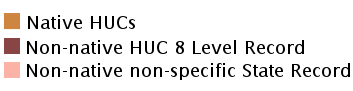
Hydrologic Unit Codes (HUCs) Explained
Interactive maps: Point Distribution Maps
Nonindigenous Occurrences:
First spotted in the U.S. in a subdivision lake in Hillsborough County, FL in 2017 (G. Lokuta, pers. comm. 2019). The plant was reported to be in cultivation across Europe by Cook and Urmi-König in 1984 but no subsequent reports have been made.
Table 1. States with nonindigenous occurrences, the earliest and latest observations in each state, and the tally and names of HUCs with observations†. Names and dates are hyperlinked to their relevant specimen records. The list of references for all nonindigenous occurrences of Egeria najas are found here.
Table last updated 2/22/2026
† Populations may not be currently present.
Ecology: Habitat: The species colonizes near shore habitats up to 3m deep and can adapt to a variety of habitats (Sousa et al. 2010).
Tolerances: Often the dominant species, E. najas successfully photosynthesizes in low light and turbid environments, allowing it to outcompete species (Tavechio 2003, Bini et al. 2010). It can also substitute bicarbonate for growth when dissolved carbon dioxide levels are low (Pierini and Thomaz 2004). The species prefers waters with conductivity levels of 60-110 microsiemens and can tolerate pH levels of 6.5-10.0 though rates of photosynthesis peak between a pH of 8.0-8.8 (Pierini and Thomaz 2004, Bini and Thomaz 2005). The lack of complex root structure prevents the plant from colonizing habitats with strong water flow and the rapid decomposition of fragments during warmer months limits its colonization ability (Carvahlo et al. 2005).
Reproduction: Seed production and therefore sexual reproduction of E. najas has rarely been observed in the wild. Egeria najas is not thought to be a sterile species however pollen transfer has rarely been observed. In natural populations of E. najas, W. Briicker and B. Luond (personal communication, 1981 in Cook and Urmi-König 1984) found that usually both sexes were present and that male flowers out-numbered females by about 4:1 or 3:1. Developing fruits with fertilized seeds were collected on 27 November 1981 (near Corrientes, Argentina), the fruits probably ripen somewhat later (Cook and Urmi-König 1984). Most reproduction of E. najas is asexual via fragmentation. Viable fragments break off at points of “double nodes”, where they are able to grow without being fully anchored in sediment (Cook and Urmi-König 1984). Roots and shoots will grow concurrently. Root fragments are able to withstand short periods of desiccation, especially in habitats that are oligotrophic or possess sand substrate (Silveira et al. 2009).
Means of Introduction: Egeria najas is available in the plant nursery trade, and likely is released via aquarium dumping.
Status: The residential pond population in Hillsborough County, FL was eradicated in 2018 after chemical treaments (G. Lokuta, pers. comm. 2019).
Impact of Introduction: The species forms dense mats concentrated just below the water surface, blocking sunlight from penetrating the water column to the detriment of photosynthetic organisms(Thomaz et al. 1999, Bini et al. 2010, Sousa et al. 2010). The loss of light may also impair the ability of predators to capture prey, as many aquatic predators rely on sight to capture prey. The species has been found to lower dissolved oxygen concentrations within patches down to 6.5 mgL-1, negatively impacting fish and other aquatic species (Bini et al. 2010). In forming dense mats, E. najas populations can clog hydroelectric facilities, interrupting energy production and requiring millions of dollars to manage the species annually (Mori 2012).
References: (click for full references)
Bini L.M., S. M. Thomaz and P. Carvalho. 2010. Limnological effects of Egeria najas Planchon (Hydrocharitaceae) in the arms of Itaipu Reservoir (Brazil, Paraguay). Limnology 11(1):39-47. https://doi.org/10.1007/s10201-009-0286-4.
Carvalho, P., S.M. Thomaz, and L.M. Bini. 2005. Effects of temperature on decomposition of a potential nuisance species: the submerged aquatic macrophyte Egeria najas Planchom (Hydrocharitaceae). Brazilian Journal of Biology 65(1):51-60. http://dx.doi.org/10.1590/S1519-69842005000100008.
Cook, C.D.K., and K. Urmi-König. 1984. A revision of the genus Egeria (Hydrocharitaceae). Aquatic Botany 19(1-2):73-96.
Lokuta, G. 2019. Personal Communication. Florida Fish and Wildlife Conservation Commission.
Mori E. S., D. Martins, E.D. Velini, C.L. Marino, C.F. Gouvea, S.M.M. Leite, E. Camacho Palomino, and R.P. Curies. 2012. Genetic diversity in Egeria densa and E. najas in Jupia Reservoir, Brazil. Ciencia e Investigacio´n Agraria 39(2):321-330. http://dx.doi.org/10.4067/S0718-16202012000200008.
Sousa W., S.M. Thomaz, and K.J. Murphy. 2010. Response of native Egeria najas Planch. and invasive Hydrilla verticillata (L.f.) Royle to altered hydroecological regime in a subtropical river. Aquatic Botany 92(1):40-48. https://dx.doi-org/10.1016/j.aquabot.2009.10.002.
Tavechio, W.L.G., and S.M. Thomaz. 2003. Effects of light on the growth and photosynthesis of Egeria najas Planchon. Brazilian Archives of Biology and Technology 46(2):203-209. http://dx.doi.org/10.1590/S1516-89132003000200011.
Thomaz S.M., L. M. Bini, M. C. de Souza, K. K. Kita and A. F. M. Camargo. 1999. Aquatic macrophytes of Itaipu reservoir, Brazil: Survey of species and ecological considerations. Brazilian Archives of Biology and Technology 42(1):15-22. https://dx.doi-org/10.1590/S1516-89131999000100003.
Author:
Pfingsten, I.A. and D. Rose
Revision Date: 1/5/2026
Citation Information:
Pfingsten, I.A. and D. Rose, 2026, Egeria najas Planchon: U.S. Geological Survey, Nonindigenous Aquatic Species Database, Gainesville, FL, https://nas.er.usgs.gov/queries/FactSheet.aspx?speciesID=3274, Revision Date: 1/5/2026, Access Date: 2/22/2026
This information is preliminary or provisional and is subject to revision. It is being provided to meet the need for timely best science. The information has not received final approval by the U.S. Geological Survey (USGS) and is provided on the condition that neither the USGS nor the U.S. Government shall be held liable for any damages resulting from the authorized or unauthorized use of the information.